What Is the Best Time of Year to Replace a Roof in Ontario and the Inland Empire?
In Ontario and the west Inland Empire, the best time to replace a roof is late March through June, with late October and November as the second window. The one date that matters most is the first big winter storm, so plan to have the new roof on before December.
Skip to the Answer
- About 79% of Ontario's yearly rain falls from December through March, based on NOAA 1991 to 2020 normals for Ontario International Airport.
- Cold is not our problem. Ontario's coldest month still averages a high near 67 degrees, so shingles seal fine all year.
- Heat is the summer problem. July and August average about 23 days each at 90 degrees or more, so good crews start at first light.
- Santa Ana winds run from fall into spring and peak in December, so wind is a winter planning issue too.
- A leaking or storm damaged roof should not wait for a good month. Tarp it now and plan the full job.
Why the Usual Answer Does Not Fit Ontario
Search this question and almost every page says the same thing. Fall is best. Spring is second. Winter is bad because shingles get cold and will not seal. That advice is written for New Jersey, New York and Texas, and some of those pages say so in the title.
The cold weather rule is real. Owens Corning says its shingles use a heat activated sealant strip, and it calls for extra care when air and roof temperatures are at or below 40 degrees (Owens Corning cold weather bulletin). Below that, the shingles may not seal until warmer days arrive.
Now look at Ontario. NOAA's 1991 to 2020 normals for Ontario International Airport put the average December high at 66.9 degrees and the average January high at 67.7 degrees (NOAA NCEI climate normals). The coldest monthly normal low is 43.6 degrees, and that is at night when nobody is on a roof. Our daytime roofs are almost never cold enough to stop a shingle from sealing.
So the snow state logic falls apart here. In the Inland Empire the calendar is set by three other things. Rain, heat and wind.
Ontario Roofing Weather by the Numbers
Rain Is the Real Deadline
Ontario gets about 11.6 inches of rain in a normal year, using the same NOAA normals. The catch is when it falls. December through March brings about 9.2 of those inches, or roughly 79% of the year. February alone averages 3.07 inches. June averages 0.02 inches.
NOAA also counts days with at least a tenth of an inch of rain. Ontario averages about 20 of them a year, and 14 fall from December through March. From May through October there are only about 2 such days in the whole stretch.
That is why the first winter storm is the date to plan around. A tear off opens the roof down to the wood. On a dry June day that is no risk at all. In February a crew has to watch every forecast, open only what it can dry in by evening, and keep tarps ready. It can be done, and we do it on emergency jobs, but it is slower and it costs you more stress.
If your roof inspection says the roof will not make it through another wet season, the best move is to book the job before December. Do not wait for the first leak to make the call for you.
| Month | Normal high (F) | Normal rain (in) | Days 90F or more | Rain days (0.1 in or more) | Our call |
|---|---|---|---|---|---|
| January | 67.7 | 2.57 | 0.0 | 3.4 | Workable between storms. Tear off only with a clear forecast. |
| February | 68.1 | 3.07 | 0.1 | 4.5 | Wettest month. Tarps and repairs first, full jobs on dry spells. |
| March | 71.7 | 1.64 | 0.9 | 2.7 | Rain tapers off. Late March opens the window. |
| April | 75.7 | 0.76 | 2.6 | 1.8 | Very good. Mild and mostly dry. |
| May | 79.8 | 0.30 | 5.0 | 0.9 | Best month for most roofs. |
| June | 86.4 | 0.02 | 11.1 | 0.0 | Very good. Driest month. Dawn starts begin. |
| July | 93.8 | 0.05 | 22.7 | 0.1 | Dry but hot. Fine for tile and flat roofs with early starts. |
| August | 94.9 | 0.03 | 23.8 | 0.1 | Hottest month. Shingles need extra care. |
| September | 91.3 | 0.10 | 17.5 | 0.3 | Still hot. Get estimates now to beat the winter rush. |
| October | 82.6 | 0.41 | 8.0 | 0.9 | Good. Watch Santa Ana and Red Flag days. |
| November | 74.7 | 0.80 | 1.6 | 1.8 | Good. Last easy month before the rain. |
| December | 66.9 | 1.89 | 0.0 | 3.4 | Rain returns and wind peaks. Plan around storms. |
Summer Heat, Shingles and Tile
Summer in Ontario is dry, which is good for roofing. It is also hot. NOAA shows an average of 22.7 days at 90 degrees or more in July, 23.8 in August and 17.5 in September. That is about 75 days from June through September.
Heat changes how a shingle roof goes on. The Asphalt Roofing Manufacturers Association says shingles get softer in hot weather, sealant gets more aggressive, and foot traffic can scuff the surface (ARMA hot weather guidance). Its advice is to install early in the day, do the west and south slopes in the morning, keep bundles out of direct sun and wear soft soled shoes. A careful crew follows that. A careless one leaves scuff marks you will see from the street.
Concrete tile is different. The tile does not care about heat. What matters on a tile re-lay is the underlayment under it. ARMA notes that self adhered membranes get more aggressive in heat, so they need more care to lay flat and straight. Ask how your crew handles that on an August afternoon.
The heat is also a safety rule. Cal/OSHA requires shade for outdoor workers when it is over 80 degrees and high heat procedures at 95 degrees and up (Cal/OSHA heat illness prevention). Ontario's normal July and August highs are 93.8 and 94.9 degrees, right at that line. Expect a summer crew to start at dawn and slow down in the afternoon. That is a sign of a crew that does it right, not a slow one.
Our take. Summer is a fine time for a tile re-lay or a flat roof. For shingles it works too, as long as the crew works mornings. If you have a choice, May and June give you dry weather without the 95 degree days.
Santa Ana Winds Run Through the Winter
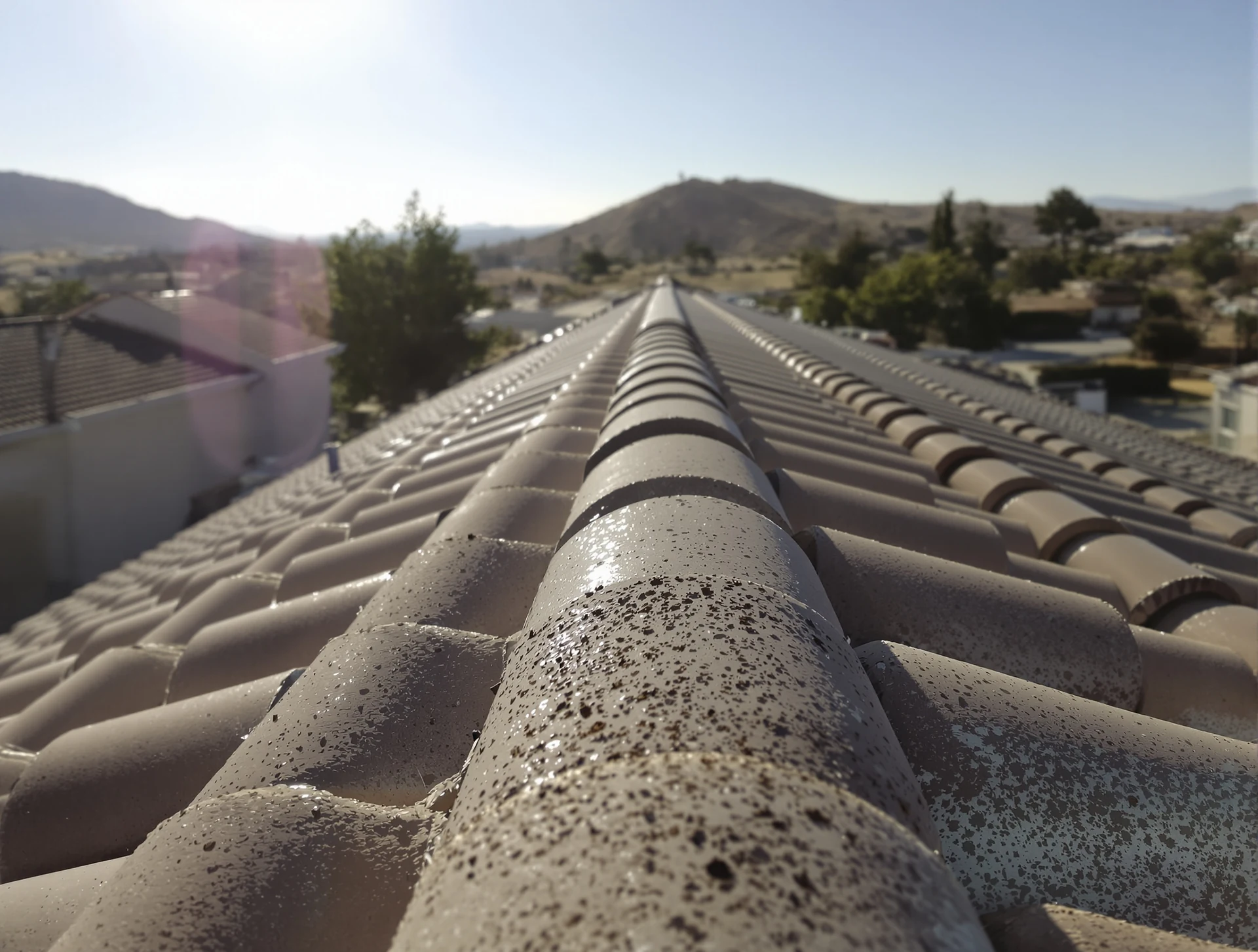
Most national pages never mention wind. Here it matters. Two climate researchers wrote in a 2014 American Meteorological Society paper that Santa Ana season usually starts in September and ends in May, with the most frequent winds in winter, especially December (Hailey and Gershunov, AMS 2014). A National Weather Service meteorologist in San Diego told Cal OES in October 2023 that the winds do not really peak until December (Cal OES).
Wind hits a roof job two ways. Loose underlayment and stacked tile can lift during a tear off. And a roof that is old and brittle loses ridge caps, tiles and shingle tabs in the first big blow. Fontana, north Rancho Cucamonga and north Upland feel it first.
October and November are still a good window, but book around the wind forecast. A good roofer keeps open sections small on windy days and pauses tear offs during a Red Flag Warning. If the wind already took pieces off your roof, call for an emergency tarp and get on the schedule before the rain.
Permits, Scheduling and Lead Time
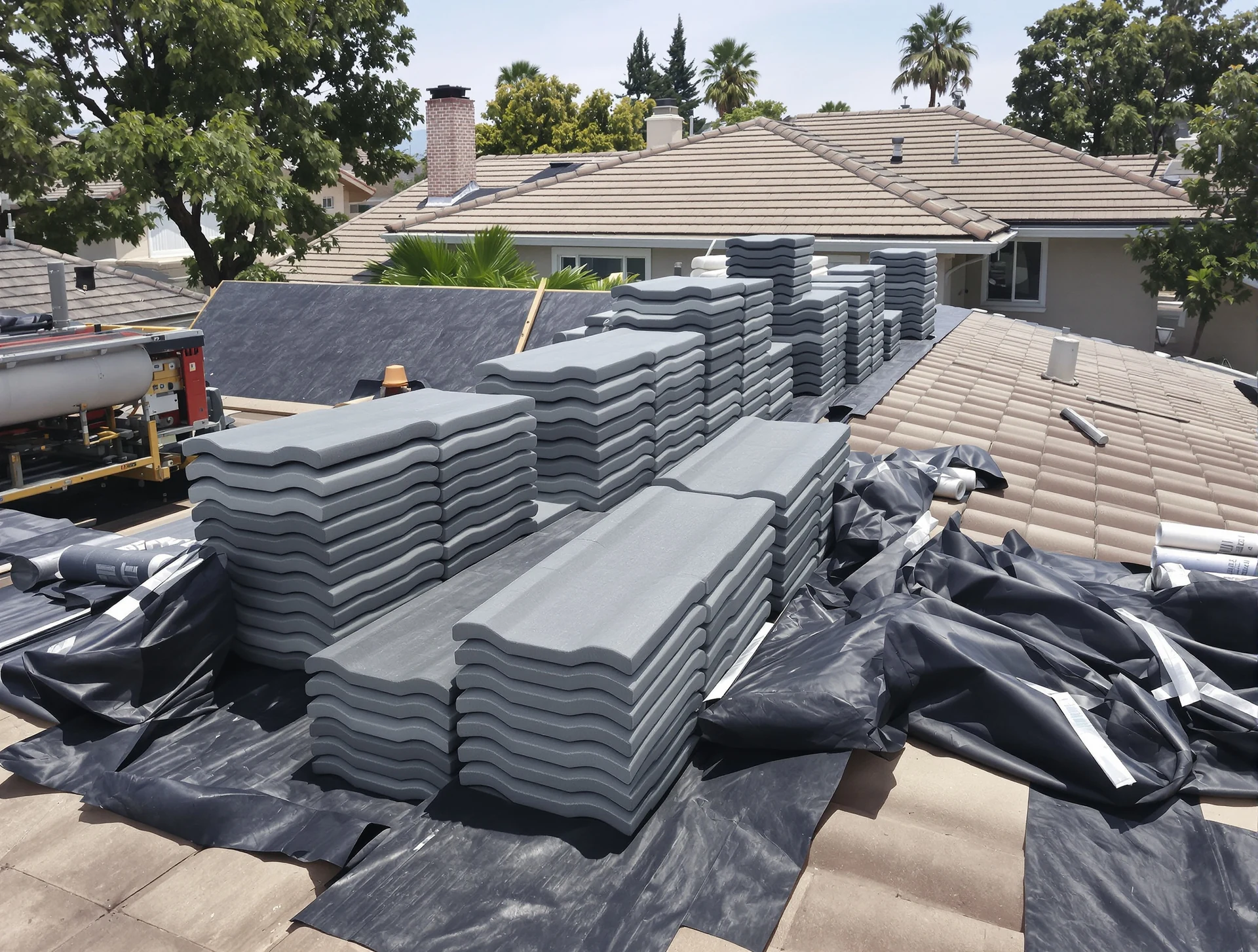
Most full roof replacements need a city permit. The City of Ontario now runs detached single family reroof permits through an automated platform with Symbium, which the city calls a streamlined process (City of Ontario reroof and solar permits). Rancho Cucamonga, Upland, Chino, Fontana and the other cities each run their own building departments, so the roofer should pull the permit and tell you the inspection steps.
Plan for more than the permit. Tile color has to match what your HOA approved. Special order tile or trim can take time to arrive. And every roofer in the region gets the same rush of calls after the first storm of the season. It happens every year.
So the simple plan is this. Get your estimate in late summer or early fall. Pick your material and get HOA approval if you need it. Then book the work for October or early November, or for spring if your roof can safely last one more winter. Use the checklist below to stay on track.
A Simple Timeline for an Ontario Roof Replacement
- July to September: get a roof inspection and written estimates while the weather is dry.
- Pick tile, shingle or flat roof material and check your HOA rules on color and profile.
- Ask the roofer who pulls the permit and what inspections your city requires.
- Book a start date in October or early November, or in late March through June.
- Clear the driveway and attic area the week before so the crew can start at dawn.
- Keep an eye on the forecast. A good roofer will move the start date for rain or a Red Flag Warning.
- After the job, keep your permit sign off and photos with your house papers.
When Not to Wait for the Best Month
A good month is a nice to have. A dry house is a must. If water is coming in, if tiles or shingles are missing, or if you can see daylight in the attic, do not wait for May.
Stop the water first with a proper tarp. Then get a written plan for the full job. A tarp buys you time to plan the replacement right. Waiting a season on an open roof costs far more than any savings from a slow month.
If you want a free written estimate on a roof replacement before the rain comes, call Ontario Roofing at (909) 404-9464.
People Also Wonder
What is the best month to replace a roof in Southern California?
For Ontario and the west Inland Empire, May is the best single month. It is dry, with a normal high near 80 degrees and only about 5 days at 90 or more, based on NOAA normals. April, June, October and November are close behind.
Can you replace a roof in the winter in Ontario CA?
Yes. It does not get cold enough here to stop shingles from sealing during the day. The issue is rain. A crew has to work between storms and only open what it can close up the same day.
Is it too hot to put on a new roof in summer?
No, but it changes how the job is done. Crews should start at first light, work the sunny slopes in the morning and keep foot traffic off soft shingles in the afternoon, as the Asphalt Roofing Manufacturers Association advises.
Should I wait for a better season if my roof is leaking?
No. Stop the water now with a tarp and plan the full replacement for the next dry stretch. Water in the attic and walls costs more every week it sits.
Do Santa Ana winds affect when I should replace my roof?
Yes. Santa Ana season usually runs from September to May and peaks in December. Book fall jobs around the wind forecast, and replace a brittle roof before the strongest winds arrive.
Do I need a permit to replace my roof in Ontario?
In most cases, yes. The City of Ontario handles detached single family reroof permits through a streamlined online platform with Symbium. Your roofer should pull the permit and schedule the inspections.
Further Proof
- NOAA NCEI: 1991 to 2020 monthly climate normals, Ontario International Airport (USW00003102)
- Owens Corning: Technical Bulletin, Cold Weather Shingle Installation (Pub. 10022497-A, April 2026)
- Asphalt Roofing Manufacturers Association: Recommendations for Storage and Application of Asphalt Roofing Shingles in Hot Weather
- American Meteorological Society: Hailey and Gershunov, Santa Ana Winds and Their Impacts on Southern California (2014)
- Cal OES: Impending Santa Ana Winds Bring Increased Fire Risk to Southern California (October 14, 2023)
- Cal/OSHA: Heat Illness Prevention
- City of Ontario: Apply for Residential Reroof and Solar Permits
Want more roof advice from us when you search Google?
Like this? Add Ontario Roofing to your Google sourcesNext Moves
We do this work in Ontario, Rancho Cucamonga, Upland, Chino, Chino Hills, Fontana, Montclair, Eastvale, Pomona, Claremont. See every service.
Where to Find Ontario Roofing
4335 E Lowell St Ste G, Ontario, CA 91761
Get a Free Roof Estimate
Tell us what your roof is doing. We look, take photos and give you a written price.