How to Replace a Roof With Solar Panels on It in Ontario, CA
You take the panels off, replace the roof, and put the same panels back, with a licensed solar or electrical contractor handling the system and a roofer handling the roof. The roof work is the easy half to plan. The panel work is where the surprise bills, permit delays and net metering mistakes hide. Costs and rules updated November 2026.
Skip to the Answer
- Removing and reinstalling panels runs about $200 to $300 per panel, on top of the roof itself.1
- A C-39 roofing license covers the roof. Solar systems fall under the C-46 solar and C-10 electrical licenses.234
- Ontario runs both reroof and home solar permits through its Symbium online portal.6
- On SCE's older net metering plans, a like for like swap needs a notice form, and growing the system past the greater of 1 kW or 10% can cost you the plan.5
- By our math from NLR's PVWatts model, an 8 kW system in Ontario makes about 376 kWh in two December weeks and about 615 kWh in two August weeks.8
Why the Panels Have to Come Off
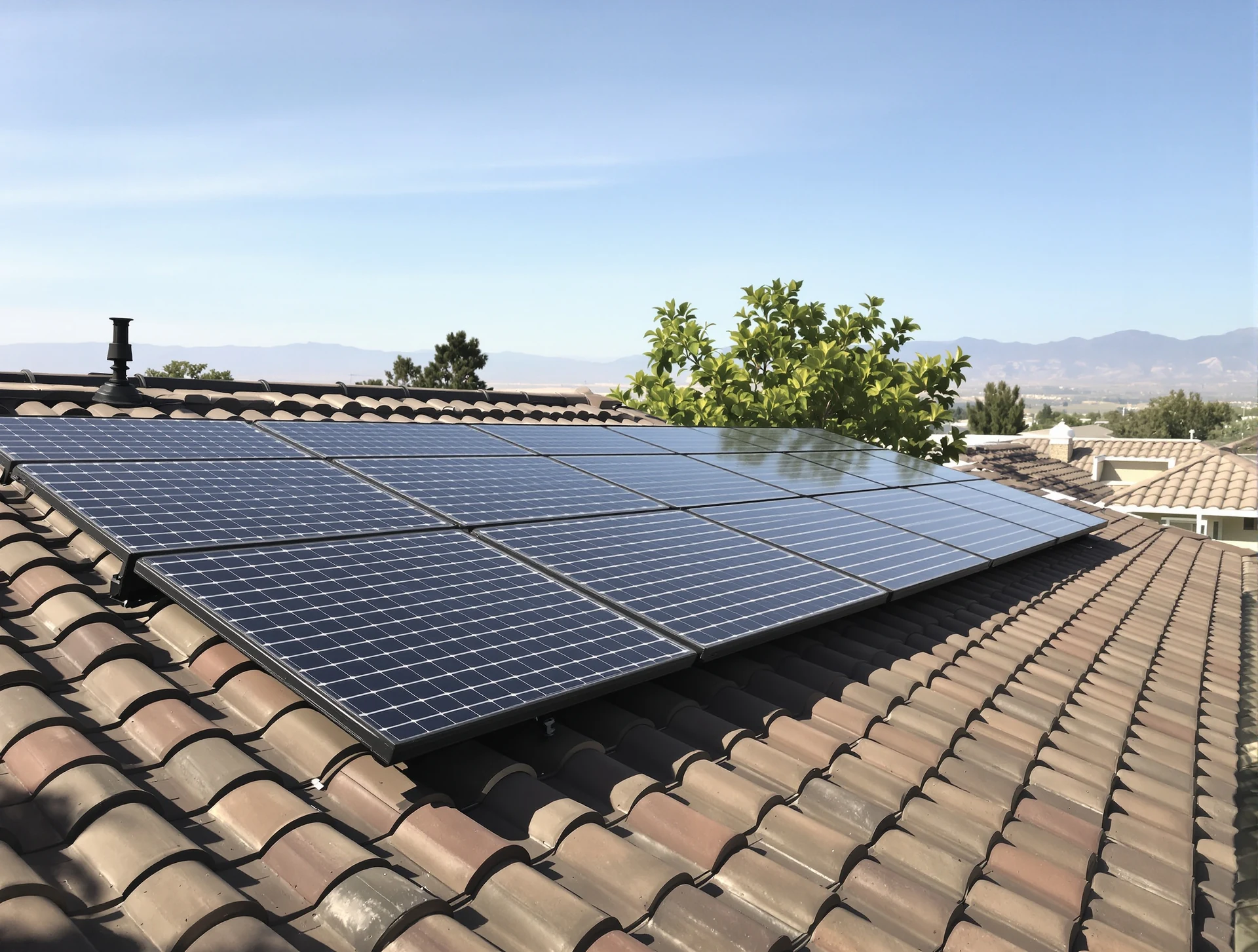
A solar array sits on rails, and the rails sit on mounts that are bolted through your roof. You can't lay new shingles or new underlayment under a panel that's still there. So when the roof is worn out under the array, the whole system comes down first.
This is a roof problem, not a solar problem. Panels last a long time. EnergySage puts the life of a home solar system at about 25 to 30 years.1 Most roofs in Ontario won't last that long in our heat. That's why the two timelines collide.
EnergySage also says that if your asphalt roof is more than 10 years old, you should probably replace it before going solar.1 Plenty of Ontario homes got panels on roofs that were already 15 or 20 years old. Those are the homes calling about this now.
Tile homes are a little different. On a concrete tile roof, the tile itself often has years left. What wears out first is the underlayment beneath it. So the job may be a tile lift and relay, not new tile. The panels still have to come off either way. Our tile roofing page explains that kind of job.
Who Can Touch the Panels in California
This is the part homeowners get wrong most often. A roofer is not automatically allowed to unwire your solar.
The Contractors State License Board says a C-39 roofing contractor installs products and repairs surfaces that seal, waterproof and weatherproof a building.2 That covers your roof, not your power system.
A C-46 solar contractor installs, modifies, maintains and repairs solar energy systems, per the CSLB.3 A C-10 electrical contractor's scope names solar photovoltaic cells by name.4 So the panel work belongs to one of those two licenses.
What that means for your bid. Many roofing companies hire a licensed solar crew for the panels. That's fine. Just ask for the name and license number of whoever is touching the system, and look both licenses up on the CSLB license check.10 If nobody can name the solar sub, keep shopping.
Call your original installer first if they're still in business. EnergySage says they know your system and their warranty may cover some or all of the cost.1
| Step | Who Does It | What to Ask For |
|---|---|---|
| Shut down and unwire the system | C-46 solar or C-10 electrical contractor34 | Name and license number of the solar crew |
| Remove, label and store panels | Same solar or electrical crew | Photos of the array and wiring before removal |
| Tear off and replace the roof | C-39 roofing contractor2 | Underlayment, flashing and tile plan in writing |
| Seal old mounts, flash new ones | Roofer and solar crew together | Who owns each mount, in the bid |
| Reroof and solar permits | Usually the contractor, through Symbium6 | Which permits are pulled and what they cost |
| Utility paperwork | Solar contractor with SCE5 | Whether Form 14-987 or a new application is needed |
| Reinstall and turn back on | C-46 solar or C-10 electrical contractor34 | A production check after the reset |
What It Costs to Pull and Reset the Panels
EnergySage says to expect about $200 to $300 per panel to remove and reinstall a system, and that the roof is a separate cost on top of that.1 It also says the total can run over $7,000 on bigger systems.1
A worked example. Say you have an 8 kW system built from 400 watt panels. That's 20 panels. At $200 to $300 each, the solar side runs about $4,000 to $6,000. Add the roof itself and any permit fees. These are example numbers for planning, not a quote.
A few things push the price toward the top of that range or past it:
Tile. Every mount on a tile roof sits under a tile that has to be lifted, and tiles can crack when they're walked on. Ask how many spare tiles are in the bid and where they'll come from.
Old parts. Clamps, rails and wiring that sat in Ontario sun for a decade or more can be brittle. Ask what happens to the price if a part breaks on the way down.
Batteries and add ons. Anything beyond the original system can trigger extra utility paperwork, which we cover below.
EnergySage also warns that removing panels can affect the panel maker's warranty, and that a solar installer's own roof warranty may not cover a roof they told you to replace.1 Ask for every warranty answer in writing before the first panel comes down.
Permits in Ontario and the $450 Cap
The City of Ontario runs detached single family reroof permits through an automated platform with Symbium.6 Home roof mounted solar and battery systems under 38.4 kW go through the same portal, and the city says solar plan review approval can be instant.6
The city's page doesn't spell out how a remove and reinstall is handled. So ask your contractor which permits they're pulling, and get it in the bid. Our post on Ontario reroof permits covers the roof side in detail.
There's a state cap on the solar permit fee. California Government Code section 66015 says a city's fee for a home solar permit can't exceed $450, plus $15 per kilowatt above 15 kW.7 A city can charge more only if it adopts written findings showing its real cost.7 The law doesn't mention reinstalls by name, so treat it as a ceiling to ask about, not a promise. That section runs until January 1, 2034.7
Keep Your Net Metering Plan Safe
If your bill comes from Southern California Edison and you went solar years ago, you may be on an older net metering plan. That plan is worth protecting.
SCE's net metering FAQ says customers on NEM 1.0 and 2.0 can keep their plan if they grow the system by no more than the greater of 1 kW or 10% of its original size.5 Going past that can mean losing the plan.5
The same FAQ says a qualified like for like equipment swap doesn't need a new application, but it does need SCE's Form 14-987.5 It also says that if a change raises or lowers the system's output, you need to tell SCE.5
The trap is the upgrade talk. With the panels already on the ground, it's tempting to add a few more or a battery. SCE says added panels need a new interconnection application, and you shouldn't run the new equipment until SCE gives a new Permission to Operate.5 Get the solar contractor to confirm with SCE, in writing, before anything changes size.
SCE's FAQ doesn't address a plain remove and reinstall of the same panels. A same system reset shouldn't change your size, but have your solar contractor confirm the paperwork with SCE before the panels come down.
When to Take the Panels Off
Every day the panels are off is a day they make nothing. When you do the job changes how much that costs.
We ran Ontario's coordinates through NLR's PVWatts calculator for an 8 kW system facing south at a 20 degree tilt, with the tool's standard losses.8 By our math from that model, the system makes about 13,317 kWh a year. It makes about 26.8 kWh a day in December and about 44 kWh a day in August.8
So two weeks off in December costs about 376 kWh. Two weeks off in August costs about 615 kWh.8 The same math gives about 435 kWh for two weeks in February, 553 in April and 613 in June.8 At California's average home power price of 29.75 cents per kWh in August 2026, that's roughly $112 against $183.9 Your real rate and plan will differ, so read that as a worked example.
But winter is when it rains. NOAA's normals for Ontario airport show 3.4 days in December and 4.5 in February with a tenth of an inch of rain or more.11 August averages 0.1 and October 0.9.11 A roof that's open under a missing array is a roof you don't want open in a storm.
Our take. Fall and spring are the sweet spot here. October loses about 502 kWh over two weeks, far less than summer, and it's still one of the driest months of the year.^8]11 If your roof is leaking now, don't wait for the perfect month. Get it [inspected and tarped first.
Solar Power Lost in Two Weeks Off the Roof
Mistakes That Show Up Later
Most solar reroof problems don't show up on day one. They show up in the first real rain.
Reusing old holes. Every old mount leaves holes in the deck. Each one should be sealed, and each new mount should be flashed into the new roof. Ask the roofer and the solar crew who owns that step, because each one may assume the other does it.
No photos of the wiring. Ask the solar crew to photograph the array, labels and wire runs before removal. It speeds up the reset and settles arguments later.
No production check after. Check your monitoring app the first sunny week after the reset. Compare it to the same week last year. A dead string can hide for months on a bill.
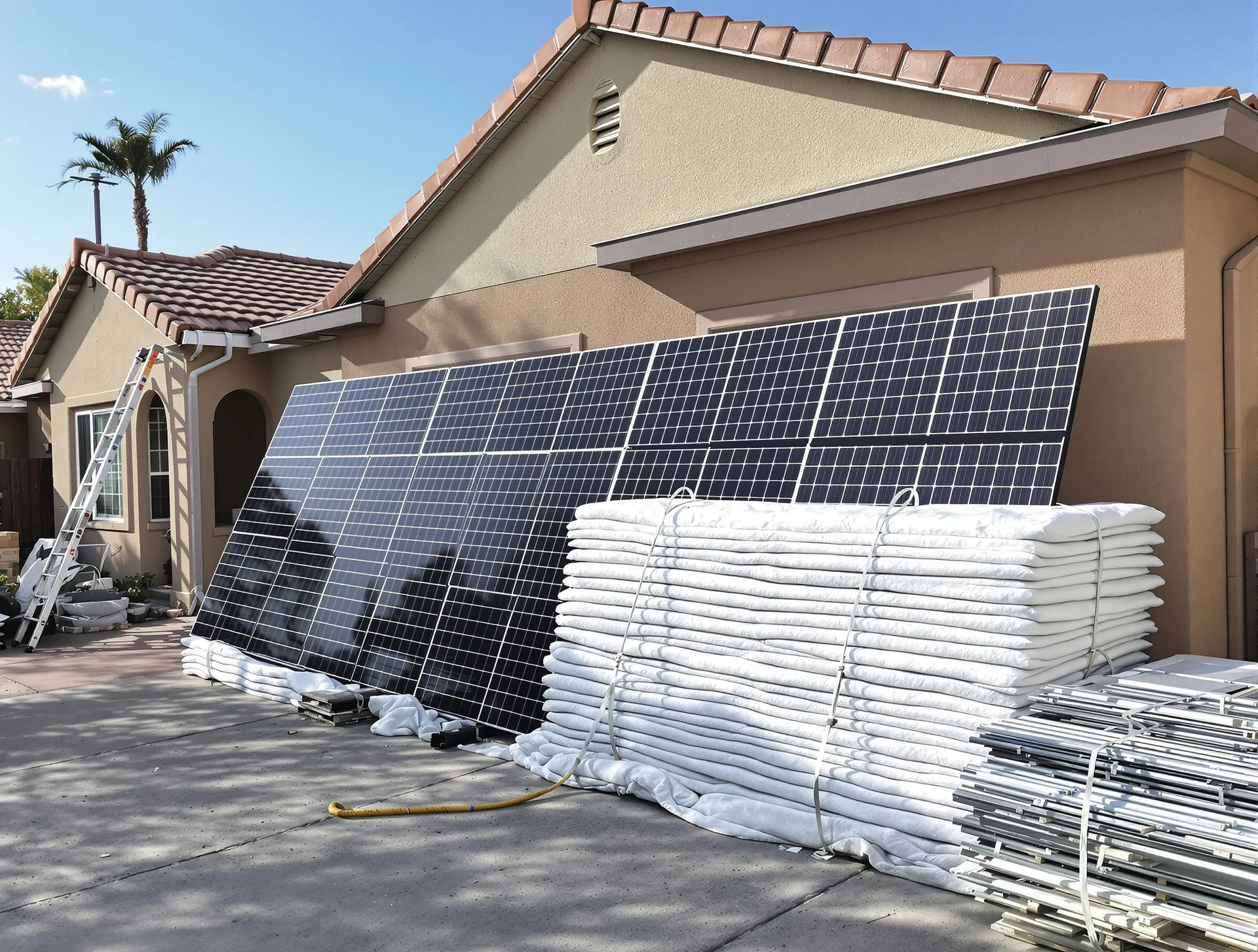
Panels stored where they get hit. Panels leaned against a wall on a busy driveway get bumped by trucks and dumpsters. Ask where they'll sit and how they'll be covered.
Your Solar Reroof Checklist
- Find your solar contract, warranty and SCE interconnection papers.
- Call your original installer and ask what their warranty covers for a reset.
- Get a roof bid and a solar remove and reinstall bid, or one bid that names both crews.
- Look up every license on the CSLB site.
- Ask which permits are pulled and what the fees are.
- Decide now if you want more panels or a battery, and have SCE confirm it first.
- Pick a dry window, ideally fall or spring.
- Ask for photos of the array and wiring before removal.
- Check your monitoring app the first sunny week after the reset.
People Also Wonder
How much does it cost to remove and reinstall solar panels for a new roof?
EnergySage puts it at about $200 to $300 per panel, plus the roof.1 A 20 panel system would run about $4,000 to $6,000 at that rate, as a worked example.
Can a roofer remove solar panels?
Not on a roofing license alone. The CSLB's C-39 scope covers the roof surface, while solar systems fall under the C-46 solar and C-10 electrical licenses.234 Many roofers bring in a licensed solar crew for that part.
Will I lose net metering if I take my panels off for a new roof?
SCE lets NEM 1.0 and 2.0 customers keep their plan if the system grows by no more than the greater of 1 kW or 10%.5 A like for like swap needs Form 14-987.5 Have your solar contractor confirm the paperwork with SCE before work starts.
How long will my solar be off during a reroof?
It depends on the roof, the crew and the permits. Each day off costs power. By our PVWatts math, an 8 kW Ontario system makes about 27 kWh a day in December and 44 in August.8
Should I replace my roof before installing solar?
Usually, if the roof is getting old. EnergySage says an asphalt roof more than 10 years old should probably be replaced before going solar.1 Doing the roof first saves paying to pull the panels later.
Do I need a permit to put solar panels back on in Ontario?
Plan on it. Ontario handles reroof and home solar permits through its Symbium portal.6 State law caps a home solar permit fee at $450 for systems up to 15 kW unless the city shows higher costs.7
Further Proof
- EnergySage: Do You Need a Roof Replacement With Solar Panels? (updated May 15, 2026)
- Contractors State License Board: C-39 Roofing Contractor
- Contractors State License Board: C-46 Solar Contractor
- Contractors State License Board: C-10 Electrical Contractor
- Southern California Edison: Net Energy Metering FAQ
- City of Ontario: Apply for Residential Reroof and Solar Permits
- California Government Code section 66015
- National Laboratory of the Rockies: PVWatts Calculator (8 kW, south, 20 degree tilt, Ontario, CA)
- US Energy Information Administration: Electric Power Monthly, Table 5.6.A, Average Price of Electricity by State
- Contractors State License Board: Check a License
- NOAA NCEI: 1991 to 2020 monthly climate normals, Ontario International Airport (USW00003102)
Want more roof advice from us when you search Google?
Like this? Add Ontario Roofing to your Google sourcesNext Moves
We do this work in Ontario, Rancho Cucamonga, Upland, Chino, Chino Hills, Fontana, Montclair, Eastvale, Pomona, Claremont. See every service.
Where to Find Ontario Roofing
4335 E Lowell St Ste G, Ontario, CA 91761
Get a Free Roof Estimate
Tell us what your roof is doing. We look, take photos and give you a written price.