The Roof Leak Insurance Guide for California Homeowners
Home insurance pays for a roof leak when something sudden, like wind, hail or a falling tree, breaks the roof open, and it usually won't pay when the water got in because the roof wore out.12 The cause is the whole claim, so the first thing an adjuster asks is why the roof failed, not how wet the ceiling got. Policy rules updated October 2026.
Skip to the Answer
- A standard HO-3 policy leaves out wear and tear, deterioration and faulty upkeep.1
- For your belongings, rain damage is covered only when wind or hail first makes an opening in the roof.1
- The policy pays the reasonable cost of a tarp or other steps that keep a covered loss from getting worse.1
- Mold or rot from a roof leak is excluded in the sample policy, since gutters and roof drains don't count as plumbing.1
- California's standard fire policy gives you 12 months from the loss to sue, or 24 months after a declared state of emergency.3
- Your insurer has 15 days to answer your claim and 40 days after proof of claim to accept or deny it.45
Why the Cause Decides the Claim
A homeowners policy is built to pay for accidents. It is not built to pay for a roof getting old.
The sample HO-3 policy from the Insurance Services Office spells this out. It won't cover loss to the house caused by wear and tear, marring or deterioration.1 It also leaves out loss from faulty or defective workmanship, materials or maintenance.1
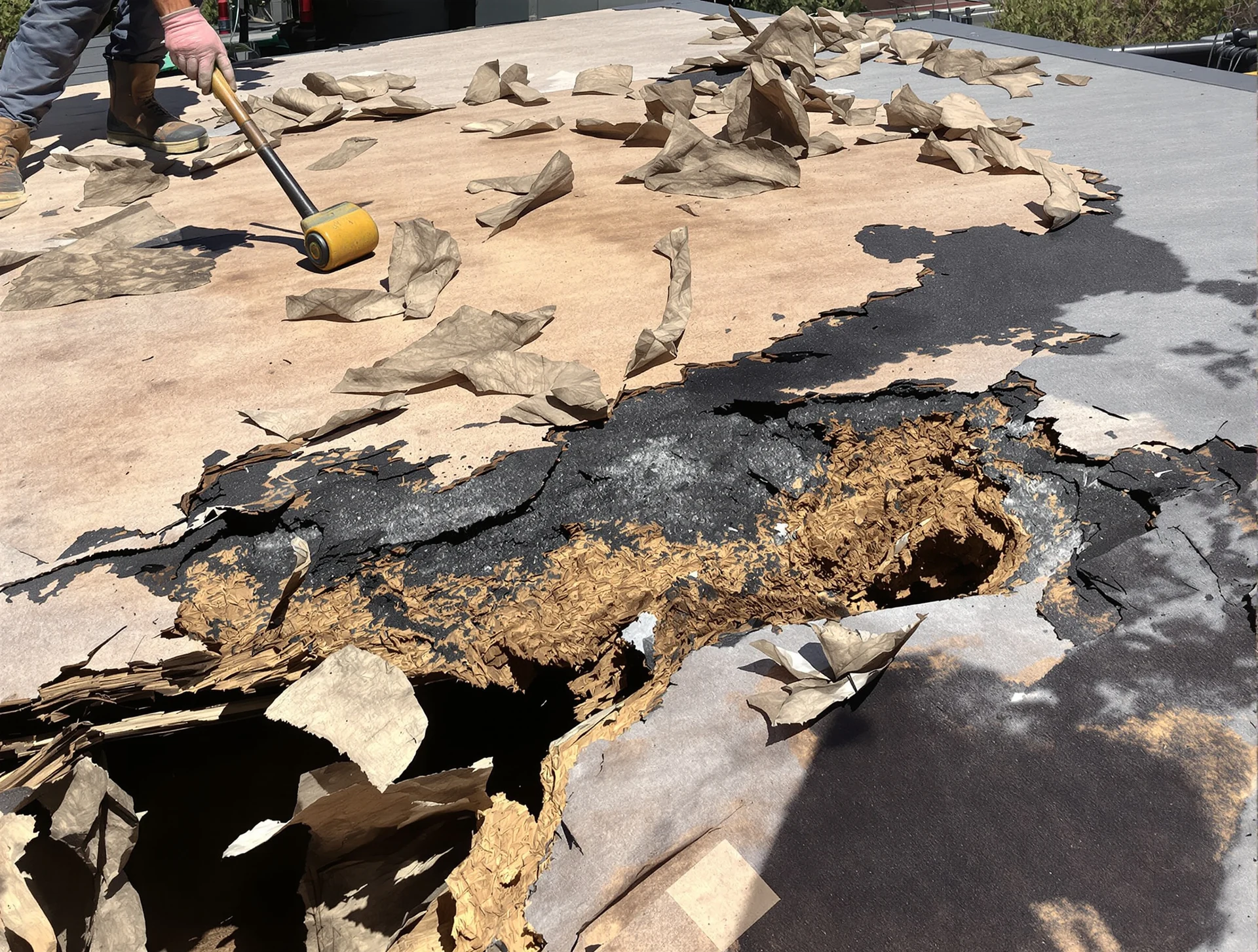
So two leaks that look the same from the living room can end two different ways. A Santa Ana wind that peels off a row of ridge tiles is a sudden event. Water that seeps through 25 year old underlayment under perfectly good tile is wear.
On a concrete tile roof, that second kind is common. The tile is rarely the problem. The felt under it dries out and cracks in our heat, and the leak shows up the first big storm of the year. Our tile roofing page shows what that layer looks like.
There is one bright spot in the exclusion. The policy still covers an ensuing loss that isn't excluded somewhere else.1 Ask your agent how your own policy reads that line.
What Your Policy Usually Pays For
Wind and hail damage. Torn shingles, lifted or broken tile and flashing bent back by wind are the classic covered roof claims. The sample policy covers rain damage to your belongings only when the direct force of wind or hail first makes an opening in the roof or wall.1
A falling tree or limb. The Insurance Information Institute says that when a storm drops a tree on your house, the damage to your roof is covered.2
The tarp. This one gets missed. The sample policy pays the reasonable cost of steps you take to protect covered property from more damage.^1] It also tells you to keep a record of what those repairs cost.1 Keep the receipt from any [emergency roof repair.
Inside damage that follows a covered break. Wet drywall, ceiling paint and soaked carpet are often part of the same claim when the roof opening itself was caused by a covered event.
How much you get back is a separate question. Triple-I notes that with actual cash value coverage, the depreciation taken off an old, worn roof can be large.2 Some California carriers now pay only actual cash value on older roofs, as the next section shows.
What It Usually Won't Pay For
A worn out roof. Age, deterioration, cracked underlayment and loose nails from years of heat all fall under wear and tear.1
Slow seepage. Triple-I says water seepage is excluded under the HO-3 and treats it as upkeep.2 A leak that drips for months before anyone sees it often lands here.
Mold and rot. The sample policy excludes mold, fungus and wet rot. Its one exception is for hidden mold from a burst plumbing, heating or air conditioning system, and it says a roof drain, gutter or downspout is not part of that system.1
Neglect after the leak starts. The policy excludes loss when the owner fails to use all reasonable means to save the property at and after the loss.1 A bucket in the hallway for three weeks with no tarp on the roof hands the insurer a reason to cut the claim.
Bad work by a past roofer. Faulty workmanship is excluded.1 That usually becomes a question for the roofer who did the job, not your insurer.
| What Caused the Leak | Usually Covered? | Why |
|---|---|---|
| Wind lifts or breaks tile or shingles | Yes | Windstorm is a covered peril |
| Hail cracks the roof | Yes | Hail is a covered peril |
| Tree or limb falls on the roof | Yes | Sudden damage from an outside cause |
| Old underlayment under the tile gives out | No | Wear and tear, deterioration |
| Slow drip for months | No | Seepage and neglect |
| Mold or rot from the leak | Rarely | Mold and wet rot exclusion |
| Bad flashing from a past repair | No | Faulty workmanship |
| Tarp after a covered break | Yes | Reasonable repairs clause |
California Roof Rules Are Getting Tighter
The roof's age matters more in California than it did a few years ago. In May 2026, Insurance Business reported on a review of filings from the 20 largest home insurers in the state, which wrote 90 percent of the homeowners premiums in 2024.7
The article reported that Farmers may give only actual cash value coverage on asphalt roofs older than 15 years. Mercury and Wawanesa generally won't insure homes with roofs older than 25 years, with exceptions for tile and slate.7 Many insurers also want flat roofs to have a minimum slope.7
The California FAIR Plan has its own line. It won't give full replacement cost coverage on homes more than 25 years old unless the roof was replaced within that period.7
If you carry the FAIR Plan, read your policy before the rain starts. The FAIR Plan describes itself as basic fire coverage, and points owners who need more toward a separate Difference in Conditions policy.6 Without one, a storm leak may have no coverage at all.
That is why it pays to have a roof inspection on file before a claim. Photos that show a sound roof before the storm are much harder to call wear and tear afterward.
Why Ontario Leaks Show Up All at Once
Ontario gets almost all of its rain in five months. At Ontario International Airport, the 1991 to 2020 normals put yearly rain at about 11.64 inches, and November through March brings 9.97 of them.8 That is about 86 percent.
February is the wettest month at 3.07 inches. January brings 2.57, December 1.89, March 1.64 and November 0.80. October gets 0.41, April 0.76 and June just 0.02.8
So a roof can sit dry for seven months with a problem nobody knows about. Then one storm finds it, and every leak in the neighborhood shows up the same week.
That timing matters for your claim. The adjuster will look at how old the damage is. A fresh wind break with clean edges reads very differently from a stain with rings that says the roof has been leaking every winter.
When the Rain Comes in Ontario
How to File a Roof Leak Claim Without Hurting It
Stop the water first. Your policy requires you to protect the property from more damage and make reasonable repairs.1 California's standard fire policy says the same thing.3 A tarp is not optional.
Give notice fast. The sample policy asks for prompt notice, and California's standard form says written notice without unnecessary delay.13
Take photos before anything is moved. Shoot the ceiling, the attic, the roof from the ground and any tiles or shingles in the yard. Date them.
Keep every receipt. Tarps, buckets, fans and the roofer's emergency visit all go in one folder.1
Watch the clock. The standard form asks for a signed, sworn proof of loss within 60 days after the loss, unless the company extends that time in writing.3 Ask your insurer in writing what it needs and by when.
Know their deadlines too. A California insurer has 15 days to acknowledge your claim and start its investigation.4 It then has 40 days after it receives proof of claim to accept or deny it. If it needs more time, it has to tell you in writing every 30 days.5
Get your own written estimate. Compare it to your deductible before you decide how far to push the claim. A free roof repair estimate with photos gives you something to hold up next to the adjuster's numbers.
For a free written estimate with photos of the damage, call Ontario Roofing at (909) 404-9464.
The First 48 Hours After a Roof Leak
- Move belongings and catch the water.
- Take dated photos of the ceiling, the attic and the roof from the ground.
- Get a tarp on the roof, or call someone who can do it safely.
- Save every receipt for the tarp, fans and emergency work.
- Call your agent or insurer and follow up in writing.
- Write down the claim number and the adjuster's name.
- Ask in writing what proof of loss they need and the date it is due.
- Get your own written repair estimate before the adjuster visits.
People Also Wonder
What kind of roof damage does homeowners insurance cover?
Sudden damage from a covered peril, like wind, hail, fire or a falling tree.12 It usually leaves out damage from age, wear and poor upkeep.1
What kind of water damage is not covered by insurance?
Slow seepage, damage from wear and tear and, in the sample HO-3, mold and wet rot that come from a roof leak.12 Flood also needs its own policy, according to Triple-I.2
Will insurance pay for a roof tarp?
Usually, when the roof damage itself is covered. The sample policy pays the reasonable cost of protecting covered property from more damage, so keep the receipt.1
How long do I have to file a roof leak claim in California?
Give notice right away. California's standard fire policy sets 12 months from the loss to bring a lawsuit, or 24 months after a declared state of emergency.3 Your insurer must warn you in writing at least 60 days before a time limit it plans to rely on runs out.5
Is it smart to submit an insurance claim for your roof?
It is when a covered event caused the damage and the repair costs more than your deductible. Get a written estimate first so you can compare the two.
Does the FAIR Plan cover a leaking roof?
The FAIR Plan calls itself basic fire insurance. Owners who need wider coverage are pointed to a separate Difference in Conditions policy, so check with your broker.6
Further Proof
- Insurance Services Office: Homeowners 3 Special Form, HO 00 03 10 00, sample policy (Insurance Information Institute)
- Insurance Information Institute: Am I Covered?
- California Insurance Code Section 2071, Standard Form Fire Insurance Policy (Public.Law)
- Cornell LII: 10 CCR 2695.5, Duties Upon Receipt of Communications
- Cornell LII: 10 CCR 2695.7, Standards for Prompt, Fair and Equitable Settlements
- California FAIR Plan: Home
- Insurance Business: California insurers tighten roof coverage rules (May 26, 2026)
- NOAA NCEI: 1991 to 2020 monthly precipitation normals, Ontario International Airport (USW00003102)
Want more roof advice from us when you search Google?
Like this? Add Ontario Roofing to your Google sourcesNext Moves
We do this work in Ontario, Rancho Cucamonga, Upland, Chino, Chino Hills, Fontana, Montclair, Eastvale, Pomona, Claremont. See every service.
Where to Find Ontario Roofing
4335 E Lowell St Ste G, Ontario, CA 91761
Get a Free Roof Estimate
Tell us what your roof is doing. We look, take photos and give you a written price.