Should I Give a Roofer the Insurance Check Before Work Starts?
No. In California a roofer can take a down payment of no more than $1,000 or 10 percent of the contract price, whichever is less, and every payment after that has to match work already done (B&P Code 7159.5). Keep the insurance check in your name, deposit it yourself, and pay the roofer in steps as the roof goes on.
Skip to the Answer
- The down payment cap is $1,000 or 10 percent, whichever is less, with no exception for special order materials.
- After the down payment, a roofer cannot ask for money ahead of the work done or the materials delivered.
- If you have a mortgage, your lender is usually on the check and often releases the money in steps.
- A roofer who offers to cover your deductible is asking you to join an inflated claim, and insurance fraud is a felony in California.
- Look up the license with the CSLB before you sign anything, and make sure the number matches the contract.
What California Law Says About Paying a Roofer
We get this question a lot after a windy week in Ontario. A roofer looks at the damage, helps with the claim, and then asks you to sign the insurance check over before the crew shows up. It sounds normal. In California it is not.
The rule is in the Business and Professions Code. Section 7159.5 says the down payment on a home improvement job shall not exceed $1,000 or 10 percent of the contract amount, and the lower number wins. It also says that, apart from the down payment, a contractor may not request or accept payment that exceeds the value of the work performed. Breaking either rule is a misdemeanor with a fine of $100 to $5,000, up to a year in jail, or both (B&P Code 7159.5).
The contract itself has to say this out loud. Section 7159 requires a home improvement contract to print, in bold type, that the down payment may not exceed $1,000 or 10 percent of the contract price, whichever is less. It also requires a section headed Schedule of Progress Payments with a bold line saying it is against the law for a contractor to collect payment for work not yet completed or materials not yet delivered (B&P Code 7159). If your roofing contract does not have those lines, that tells you something.
The Contractors State License Board puts it the same way on its contract page, and adds that no exception exists for special order materials (CSLB). So the line about needing the full check to order tile does not change the law. The table below shows what the cap means on real numbers. These are worked examples, not prices.
| Contract price | 10 percent | $1,000 cap | Most you can be asked to pay down |
|---|---|---|---|
| $5,000 roof repair | $500 | $1,000 | $500 |
| $9,000 re-lay | $900 | $1,000 | $900 |
| $10,000 job | $1,000 | $1,000 | $1,000 |
| $22,000 tile roof | $2,200 | $1,000 | $1,000 |
| $35,000 tear off | $3,500 | $1,000 | $1,000 |
How an Insurance Check Moves When You Have a Mortgage
If you still have a mortgage on your Ontario, Chino or Rancho Cucamonga home, that changes who gets the money. The California Department of Insurance says that when a home is mortgaged, the check for repairs is generally made out to you and the lender. The lender has to endorse it, and lenders generally put the money in an escrow account and release it to you as the work gets done. The lender may also want to inspect the finished job before it releases the last payment (CDI Residential Property Claims Guide).
That system already protects you. The lender pays out in steps, and the law says the roofer gets paid in steps. Signing the whole check over to the roofer on day one skips both. Once the money is gone, your only tool is a fight.
A second reason not to hand over the first check applies. Many policies pay replacement cost in two parts. The same CDI guide says that with replacement cost coverage you normally have to replace the damaged items before the insurer pays the full replacement cost, and you get the actual cash value if you do not replace them (CDI). The first check is often not the whole job. If it all goes to the roofer before work starts, there may be nothing left to hold them to the finish.
The CDI also tells homeowners to show the lender the contractor's bid and how much the contractor wants up front to begin. A lender who sees a roofer asking for the full check will ask the same questions you should.
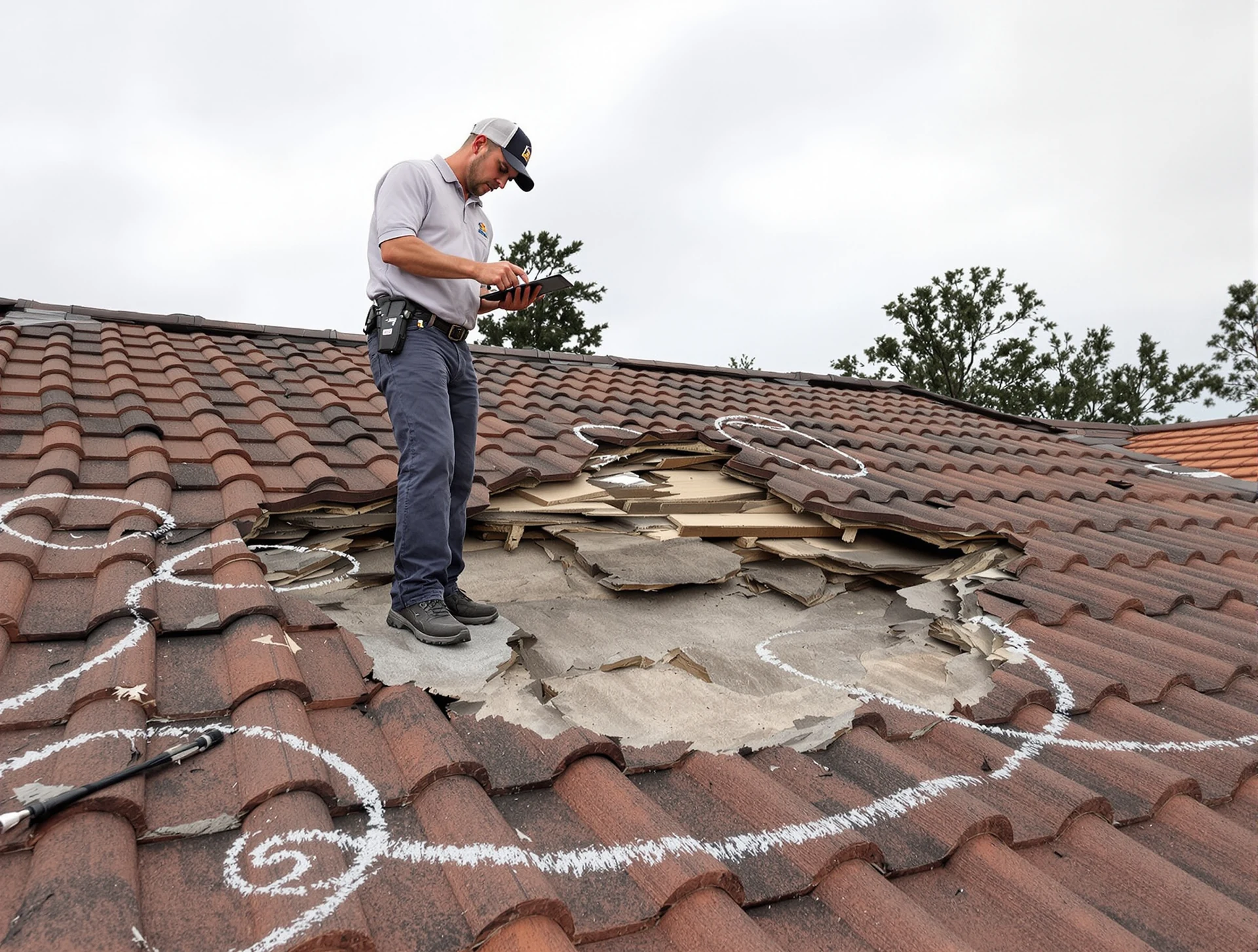
Why Some Roofers Ask for the Whole Check
Not every roofer who asks is a crook. Some spent hours on the claim, met the adjuster and took the photos. They want to know they will get paid. That is fair to want. The fix is a written contract with a clear payment schedule, not your check in their pocket.
Read anything called an insurance agreement, a contingency agreement or a direction to pay before you sign it. Some only let the roofer talk to your insurer. Others try to send the claim money straight to the contractor. If a form moves your money, treat it like a contract, because it is one.
California gives you time to back out. Section 7159 requires a Three Day Right to Cancel notice in most home improvement contracts, and senior citizens get five days (B&P Code 7159). If you signed something at the kitchen table under pressure, read that notice tonight.

Waiving the Deductible Is Not a Favor
This one sounds like a gift. A roofer says he will eat your deductible, or knock it off the price, and still bill the insurer the full amount. The money to cover that deductible has to come from somewhere, and it usually comes from a padded estimate sent to your insurance company.
California Penal Code 550 makes it a crime to knowingly present a false or fraudulent claim, or to present a statement in support of a claim that you know is false or misleading on a material fact. Breaking section 550(b) can bring two, three or five years, or county jail, and a fine of up to $50,000 or double the amount of the fraud (Penal Code 550). The Department of Insurance says insurance fraud is a felony punishable by up to five years in state prison and a $50,000 fine, and it names ordinary people who want to cover their deductible among those who commit it (CDI).
Your name is on the claim. If the bill is padded, you are the one who presented it. Pay your deductible, and walk away from any roofer who offers to make it disappear.
Red Flags After a Wind Storm in the Inland Empire
Our big roof damage days come from Santa Ana winds and the few heavy rains we get in winter. That is when door knockers start working the streets in Ontario, Fontana and Upland. The CDI lists the same warning signs for property repair fraud that we hear about from homeowners (CDI Don't Get Scammed).
The contractor shows up without being called. Storm chasers work the street after the wind dies down.
They want full cash payment up front. The CDI says never pay for the entire project in advance, and to pay by check instead of cash so you have a receipt.
No license bond or no proof of insurance. Ask for the certificate. A real roofer has it ready.
A vague estimate or a bid far below the others. A one line quote gives you nothing to hold them to.
Pressure to sign today. The CDI says not to be rushed into a contract. A real repair price will still be there tomorrow.
If the leak is active, a tarp is the right first step. Just do not let a tarp turn into a signed contract for the whole roof. Our page on emergency roof repair covers what a tarp job should look like.
Most a Roofer Can Take Up Front
How to Pay a Roofer on an Insurance Job
- Look up the roofer on the CSLB site and match the license number to the contract.
- Get a written contract with a Schedule of Progress Payments and the bold down payment line.
- Read any insurance agreement or direction to pay before you sign it.
- Deposit the insurance check yourself. If your lender is on it, send the lender the bid.
- Pay no more than $1,000 or 10 percent down, whichever is less.
- Pay each step only after the work or materials for that step are on site.
- Pay by check or card, never cash, so you have a record.
- Pay your own deductible. Walk away from any offer to cover it.
- Hold the last payment until the roof is done, cleaned up and passed by any inspection your lender or city requires.
Check the License Before You Sign
Every step above assumes you hired a licensed contractor. The CSLB checklist tells homeowners to check the license status online or by phone at 1-800-321-2752 before signing (CSLB Homeowner Checklists). Use the CSLB license lookup, confirm the license is active, and make sure the number on the contract is the same number you looked up.
The same checklist says to pay only as work is completed and not before, and to make sure you got a Notice to Owner, the form that explains liens and how to prevent them. If a roofer cannot give you a license number, a written contract and a payment schedule, the check stays in your drawer.
Not sure the roof even needs replacing? A written roof inspection with photos gives you something to compare against the adjuster's report and the roofer's bid. If it does need a full roof replacement, the steps below keep your money tied to real work.
If you are in Ontario or a nearby city and want a second set of eyes on a claim or a bid, call Ontario Roofing at (909) 404-9464 for a free written estimate.
People Also Wonder
Should I send my roofer the insurance estimate?
Sharing the adjuster's estimate after you hire a roofer is common and helps them match the approved scope. Sharing it is not the same as signing over the check. Keep the payment side in your hands and pay in steps.
Can a roofer ask for half up front in California?
No. California caps the down payment at $1,000 or 10 percent of the contract price, whichever is less, and later payments cannot get ahead of the work done (B&P Code 7159.5).
Is it illegal for a roofer to pay my deductible in California?
If the deductible gets covered by billing your insurer more than the real cost, that is a false claim under Penal Code 550. The claim is in your name, so you carry the risk too.
What if my mortgage company is on the insurance check?
The lender has to endorse it. The CDI says lenders generally hold the money in escrow and release it as the work is completed, and may inspect the job before the last payment.
Can I cancel a roofing contract after I sign it?
Most home improvement contracts in California must include a Three Day Right to Cancel notice, and senior citizens get five days (B&P Code 7159). Read the notice in your contract for the exact steps.
Further Proof
- FindLaw: California Business and Professions Code 7159.5
- FindLaw: California Business and Professions Code 7159
- FindLaw: California Penal Code 550
- CSLB: Learn About Home Improvement Contracts
- CSLB: Home Improvement Contracts, Homeowner Checklists
- CSLB: Check a License
- California Department of Insurance: Residential Property Claims Guide
- California Department of Insurance: Don't Get Scammed After a Disaster
- California Department of Insurance: Insurance Fraud Is a Felony
Want more roof advice from us when you search Google?
Like this? Add Ontario Roofing to your Google sourcesNext Moves
We do this work in Ontario, Rancho Cucamonga, Upland, Chino, Chino Hills, Fontana, Montclair, Eastvale, Pomona, Claremont. See every service.
Where to Find Ontario Roofing
4335 E Lowell St Ste G, Ontario, CA 91761
Get a Free Roof Estimate
Tell us what your roof is doing. We look, take photos and give you a written price.