Tile vs Shingle Roofs in Ontario and Inland Empire Heat
In Ontario heat, concrete tile is the better roof for most homes that can carry it. It keeps the attic cooler and outlasts shingles by decades. Shingles still win on price, speed and weight, and a cool rated shingle is the smart pick for an older ranch house or a short stay.
Skip to the Answer
- Ontario averages 93 days a year at 90 degrees or hotter and 19 days at 100 or hotter, based on NOAA normals for Ontario International Airport.
- In Oak Ridge National Laboratory tests, concrete tile let 43% less peak day heat through the roof deck than a shingle roof of the same color.
- Tile costs about two to three times more to install. HomeGuide lists $3 to $6 a square foot for asphalt shingles and $7 to $19 for concrete tile.
- The tile can last a lifetime, but the underlayment under it lasts about 30 years in California.
- Since January 1, 2026, a reroof of more than half of a sloped roof in Ontario must use a cool rated product or meet an exception. That goes for tile and shingles alike.
What Ontario Heat Does to a Roof
We see a lot of roofs in Ontario, and summer is what wears them out. Rain gets the blame because that is when leaks show up. But the damage was done in July and August.
The numbers are not close to mild. Ontario International Airport averages a high of 94.9 degrees in August and 93.8 in July. A normal year has about 93 days at 90 or hotter and 19 days at 100 or hotter. August alone averages almost 24 days at 90 plus. All of that comes from the NOAA 1991 to 2020 climate normals for that station.
Asphalt shingles feel that heat directly. The Asphalt Roofing Manufacturers Association says hot weather softens the asphalt coating, so shingles scuff and tear more easily. It tells crews to install early in the day. Year after year, sun bakes the oils out, the grit falls off, and the edges curl.
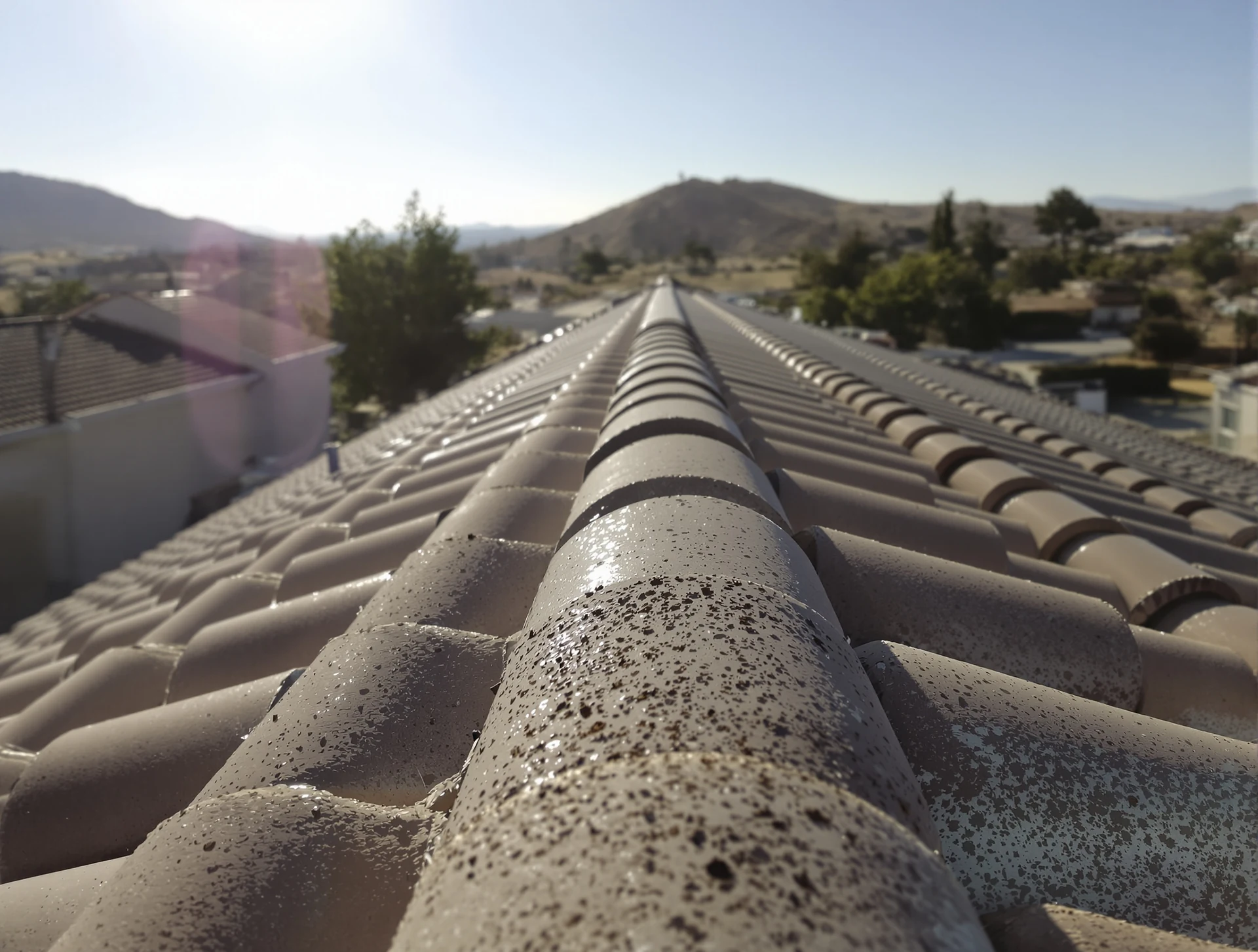
Concrete tile does not soften. It sits on battens or on the deck and sheds the sun. The weak spot on a tile roof is not the tile. It is the paper under it, which we cover below.
Why a Tile Roof Keeps the Attic Cooler
Most comparison pages get this wrong. They say tile is cooler because of its color or its mass. The bigger reason is the air gap.
Curved and raised tile leaves a space between the tile and the roof deck. Hot air in that space rises and moves out at the top. That carries heat away before it reaches the wood. Researchers at Oak Ridge National Laboratory tested this on a full attic test rig in a paper published by ASHRAE in 2013.
Their results were strong. Flat and medium profile concrete tile with almost the same color as a dark shingle let 43% less heat through the roof deck on peak days. Heat through the roof and ceiling was about half of what the shingle roof let in.
The same paper cites older field work. A 1995 test by Beal and Chandra found 45% less daytime heat through a tile roof on counter battens than through a nailed shingle roof. A 2002 study by Parker and others found an 8% lower yearly cooling load in a home with clay barrel tile than in a matching home with shingles.
One caveat. The Oak Ridge rig was in east Tennessee, and the paper says the air gap gave no thermal edge in cold climates. Ontario is the opposite case. Long hot summers are where the gap pays off most.
If your upstairs bedrooms bake every August, the roof is only half the story. Attic vents and insulation matter just as much. Our attic insulation page explains what we check.
Ontario Heat and What Tile Does About It
What Each Roof Costs and How Long It Lasts
Tile costs more. No way around it. HomeGuide, in a guide dated November 7, 2025, lists installed prices of $3 to $6 a square foot for asphalt shingles, $7 to $19 for concrete tile and $8 to $25 for clay tile. Those are national numbers.
California runs higher. A San Diego roofer, Dana Logsdon Roofing and Solar, lists 2025 California pricing of $6 to $9 a square foot for shingles and $12 to $20 for clay tile. It also says shingles take 2 to 3 days to install and tile takes 5 to 7.
Take the HomeGuide ranges. A roof with 2,000 square feet of area would run about $6,000 to $12,000 in shingles. The same roof in concrete tile would run about $14,000 to $38,000. Your real number depends on pitch, tear off, wood repair and the permit.
Life span is where tile earns its price. The InterNACHI life expectancy chart gives 20 years for three tab shingles, 30 for architectural shingles and 100 plus for clay or concrete tile. HomeGuide gives 20 to 30 years for architectural shingles and 30 to 100 plus for tile.
But the tile is not the whole roof. The underlayment under it keeps the water out. Association Reserves puts the useful life of tile underlayment in California at about 30 years. So a tile roof still needs real money around year 30. The good news is that the tile can often go back on. That job is called a re-lay, and our tile roofing page shows how it works.
| What Matters | Concrete Tile | Architectural Shingle |
|---|---|---|
| Installed price, national | $7 to $19 a sq ft (HomeGuide) | $3 to $6 a sq ft (HomeGuide) |
| Installed price, California | $12 to $20 a sq ft for clay tile (Dana Logsdon) | $6 to $9 a sq ft (Dana Logsdon) |
| Install time | 5 to 7 days (Dana Logsdon) | 2 to 3 days (Dana Logsdon) |
| Life of the top layer | 100 plus years (InterNACHI) | 30 years (InterNACHI) |
| Life of the underlayment | About 30 years in CA (Association Reserves) | Replaced with the shingles |
| Weight | About 900 to 970 lb per 100 sq ft (Eagle) | Less than half of tile (Brava) |
| Peak heat through the deck | 43% less than shingle (Oak Ridge) | The baseline |
| Cool roof rule on a reroof | Must be cool rated or meet an exception | Must be cool rated or meet an exception |
| Fire rating | Class A (Fire Safe Marin) | Class A for fiberglass shingles (Fire Safe Marin) |
The Cool Roof Rule for an Ontario Reroof
Every Ontario ZIP code, 91761, 91762 and 91764, sits in California building climate zone 10. That comes from the California Energy Commission ZIP code list.
The 2025 Energy Code took effect on January 1, 2026. Under section 150.2(b)1Ii, a home reroof on a sloped roof in zone 10 needs a product with an aged solar reflectance of at least 0.20 and a thermal emittance of at least 0.75, or a solar reflectance index of at least 16. That is from the Cool Roof Rating Council chart of the 2025 code. The Energy Commission cool roof sheet says the rule kicks in when more than half of the roof is replaced.
Some homes are exempt. A home with R-38 ceiling insulation, an attic radiant barrier, no ducts in the attic, or R-2 insulation at the roof deck counts as meeting the rule. So does a roof that weighs at least 25 pounds a square foot.
Tile does not get a free pass on weight. Eagle Roofing lists its standard concrete tile at about 900 to 970 pounds per 100 square feet. That is roughly 9 to 10 pounds a square foot, well under 25. So tile has to be cool rated too, unless the house meets another exception.
Watch the label. The CRRC chart says a shingle with no rating label is treated as having an aged reflectance of just 0.08. That fails the 0.20 bar. Cool rated products come in tile and asphalt, and the Energy Commission sheet notes they come in dark colors too, not just white. Ask to see the CRRC label before the material shows up. Our shingle roofing page covers how we pick a cool rated shingle.
Weight, Framing and Fire
Tile is heavy. Eagle lists even its lightweight tile at 550 to 720 pounds per 100 square feet. Brava Roof Tile says concrete tile weighs more than double what asphalt shingles do.
That matters most on older ranch homes in Ontario, Montclair and Upland. Many were built for shingles. Putting tile on one can mean an engineer, a permit review and new framing. Going the other way, from tile to shingles, is easy on the frame. The questions are looks and your HOA.
On fire, both can be Class A. Fire Safe Marin lists asphalt fiberglass shingles, concrete tile and clay tile as common Class A coverings. It also warns that tile can leave gaps at the ridge and the edges. Birds nest there, and embers can light the nest. Those gaps should be closed with bird stops and checked.
Questions to Ask Before You Choose
- What is on the roof now, and how old is the underlayment?
- Was the house framed for tile, and will the city want an engineer?
- Does the product have a CRRC label with an aged reflectance of 0.20 or more?
- Does the house meet a cool roof exception, like R-38 in the attic or no attic ducts?
- Does your HOA limit the color or the roof type?
- How long do you plan to own the home?
Which One We Would Pick for an Ontario Home
If the house already has tile and the tile is in good shape, keep it. A re-lay with new underlayment gives you the cool attic and the long life for much less than a new tile roof.
If the house was framed for shingles, stay with shingles. Pick an architectural shingle with a CRRC cool rating in a color you like. Add attic venting if the attic runs hot.
If you plan to stay 20 years or more, the frame can carry it and the budget allows, tile pays you back in comfort and in fewer reroofs.
If you plan to sell in a few years, shingles make more sense. Buyers care that the roof is new and leak free. They rarely pay you back the full gap in price.
Not sure what you have under there? A roof inspection tells you the age of the underlayment, the state of the deck and what the framing can hold. Call Ontario Roofing at (909) 404-9464 for a free written estimate on either roof.
People Also Wonder
Which is better, tile or shingle roof?
In Ontario heat, concrete tile is better over the long run. It keeps the attic cooler and the tile itself can last a lifetime. Shingles cost about half as much or less, go on in a few days and work on any frame. Pick tile if the frame can carry it and you will stay a long time.
How many years will a tile roof last?
HomeGuide gives 30 to 100 plus years for tile, and InterNACHI lists 100 plus for clay or concrete. The underlayment under it lasts about 30 years in California, according to Association Reserves. Plan on new underlayment around year 30, often with your same tile put back on.
How long do shingles on a roof last?
InterNACHI gives 20 years for three tab shingles and 30 years for architectural shingles. In Inland Empire sun, the grit loss and curling we see often show up toward the low end of that range.
What are the disadvantages of tile roofs?
Tile costs more, takes longer to install and weighs a lot, so older homes may need new framing. Tiles crack if you walk on them wrong. And the paper under the tile wears out long before the tile does.
What are the disadvantages of shingles?
Shingles wear out faster in heat. The sun bakes out the oils, the grit falls off and Santa Ana winds lift the weak edges. They also let more heat into the attic than tile does.
Do I need a cool roof when I reroof in Ontario?
Usually yes. Since January 1, 2026, a reroof of more than half of a sloped roof in climate zone 10 needs a product with an aged solar reflectance of 0.20 or more, unless the house meets an exception such as R-38 ceiling insulation or no ducts in the attic.
Further Proof
- NOAA NCEI: 1991 to 2020 annual climate normals, Ontario International Airport (USW00003102)
- NOAA NCEI: 1991 to 2020 monthly climate normals, Ontario International Airport (USW00003102)
- Oak Ridge National Laboratory: Thermal Performance of the Exterior Envelopes of Whole Buildings XII, sub-tile venting paper (ASHRAE, 2013)
- Cool Roof Rating Council: Chart of 2025 California Energy Code Cool Roof Requirements (December 4, 2025)
- California Energy Commission: Energy Efficient Cool Roofs, Single Family Residential
- California Energy Commission: Climate Zone Assignments by ZIP Code
- HomeGuide: How Much Does a Roof Replacement Cost? (November 7, 2025)
- Dana Logsdon Roofing and Solar: Shingle Roofs vs Tile Roofs in San Diego (June 12, 2025)
- InterNACHI: Standard Estimated Life Expectancy Chart for Homes
- Association Reserves: Should We Reserve for Tile Roof Replacement? (February 6, 2019)
- Eagle Roofing: Technical Specifications
- Brava Roof Tile: Concrete Tile Roof vs. Asphalt Shingles
- Asphalt Roofing Manufacturers Association: Storage and Application of Asphalt Roofing Shingles in Hot Weather (February 22, 2024)
- Fire Safe Marin: Fire Resistant Roofs
Want more roof advice from us when you search Google?
Like this? Add Ontario Roofing to your Google sourcesNext Moves
We do this work in Ontario, Rancho Cucamonga, Upland, Chino, Chino Hills, Fontana, Montclair, Eastvale, Pomona, Claremont. See every service.
Where to Find Ontario Roofing
4335 E Lowell St Ste G, Ontario, CA 91761
Get a Free Roof Estimate
Tell us what your roof is doing. We look, take photos and give you a written price.