How to Stop a Roof Leak That Keeps Coming Back
A roof that leaks again after a repair usually means the fix went on the wrong spot, fixed one of two spots, or fixed the roof when the water came from somewhere else. In Ontario the dry season hides a bad repair for months, so the first big storm of the winter is often the first real test. Rules and rain figures updated November 2026.
Skip to the Answer
- Water can travel several feet along the deck and framing before it drips, so the stain on the ceiling is rarely the hole.2
- Ontario averages about 2.3 days a year with a tenth of an inch of rain or more from May through October, so a summer repair can sit untested until winter.1
- On concrete tile, the tile sheds most of the water and the underlayment below it is the backup layer. A leak there is usually that layer, not the tile.3
- A drip in July when it hasn't rained is often the air conditioner's drain pan in the attic, not the roof.41
- California lets you file a complaint with the CSLB for up to four years from the date of the act, and a willful departure from good workmanlike trade standards is a cause for discipline.98
Why the Same Leak Comes Back
A repeat leak is almost never bad luck. It's one of four misses, and each one has a different fix.
The repair went where the stain was, not where the water got in. Rain that slips past the roof can run down the sheathing and along a rafter before it drops onto the ceiling. A guide on finding roof leaks warns that the leak itself may be several feet to either side of the wet insulation you find in the attic.2 A roofer who patches the shingles straight above the stain can do perfect work on the wrong spot.
There were two leaks, and only one got fixed. A tired roof rarely fails in just one place. Fix the worst spot, and the next storm finds the second one. To you it looks like the same leak, because it lands on the same ceiling.
The patch fixed the top layer, and the bottom layer is what failed. This is the big one on the concrete tile roofs that cover so many Ontario, Rancho Cucamonga and Fontana tract homes. A Tile Roofing Institute expert explains that modern concrete tile is dense enough to be the main water shedding layer, with the underlayment below as the backup barrier.3 Swap a cracked tile over a rotted underlayment, and the water still finds the deck.
Old parts went back on. California's residential code says that on a reroof, existing flashings, edgings, vents and similar devices must be replaced where they're rusted, damaged or deteriorated, and flashings must be rebuilt to the maker's instructions.4 A crew that reuses a cracked vent collar or a rusted wall flashing to save an hour has left the leak in place under a brand new roof.
Ontario's Dry Season Hides a Bad Repair
Most leak advice says to wait for one good storm before you judge a repair. In Ontario that can mean waiting half a year.
NOAA's 1991 to 2020 normals for Ontario International Airport show only 0.9 days in May, none in June, 0.1 in July, 0.1 in August, 0.3 in September and 0.9 in October with a tenth of an inch of rain or more.1 Add those up and the six warm months get about 2.3 real rain days. The wet months look nothing like that, with 1.8 days in November, 3.4 in December, 3.4 in January, 4.5 in February, 2.7 in March and 1.8 in April.1 The five months from November through March get about 15.8, by our math from the same normals.1
So a repair done in June often gets its first real test in December. By then the roofer has been paid, the job is closed, and any written workmanship promise may be running out. It's also when the roof is under the most water, since January averages 2.57 inches and February 3.07.1
Don't wait for the weather to grade the work. A hose test can mimic a storm on a dry day, and it's a fair thing to ask a roofer to do before you sign off on a leak repair. The method is in the steps below.
Days With Real Rain in Ontario, by Month
When It's Not the Roof at All
Some repeat leaks never were roof leaks. Every roofer who's chased a summer drip has learned to look for these first.
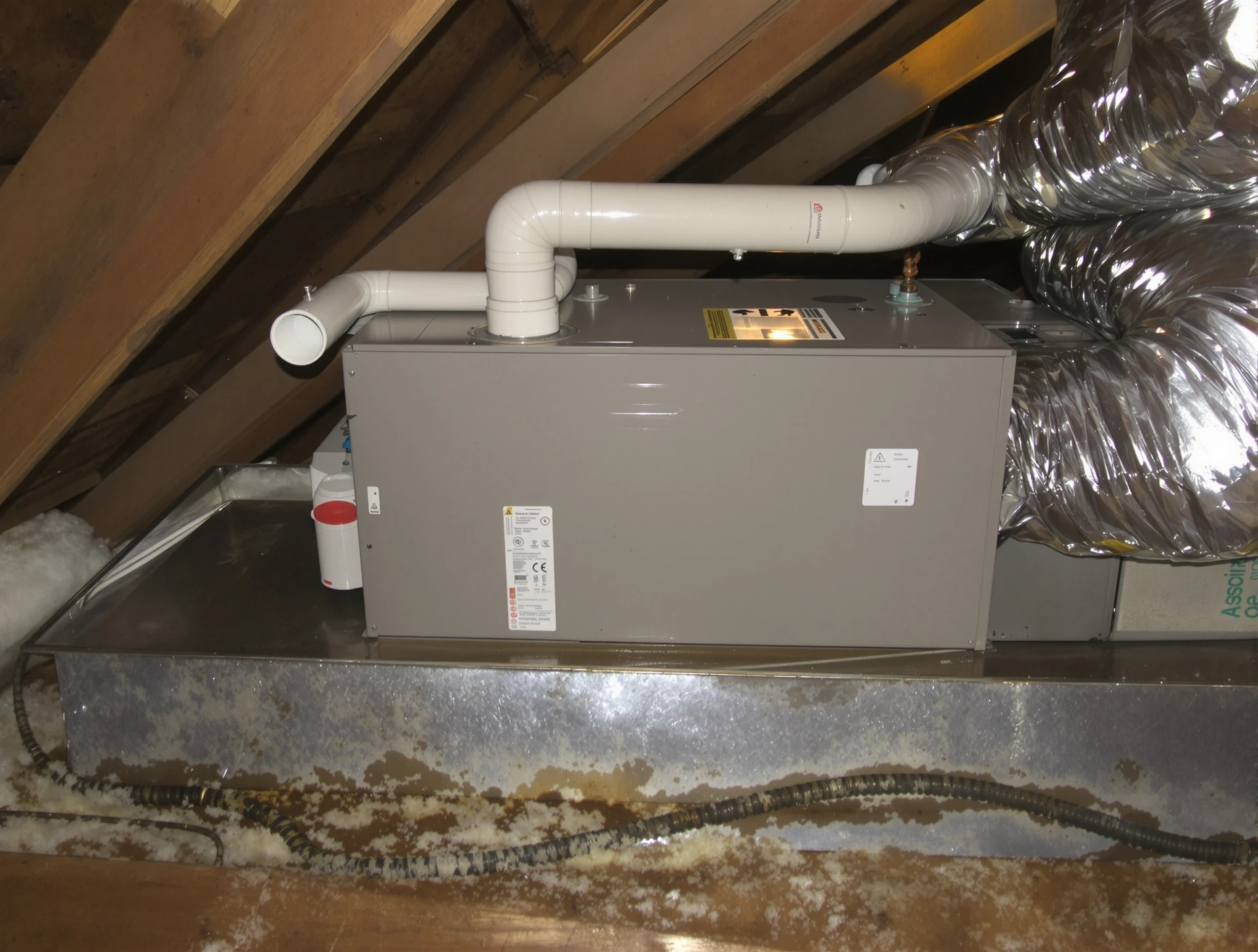
The air conditioner in the attic. Plenty of Inland Empire homes have the furnace and air handler up in the attic. Building scientist Allison Bailes explains that an air conditioner has two drain pans, one inside the unit under the coil and a second one under the whole air handler. The most common reason for water in that lower pan is a clogged condensate drain, which fills the inner pan first and spills into the lower one.5 If that pan overflows or rusts through, the water lands on your ceiling.
Use the calendar to sort it out. If the drip shows up in July or August, when Ontario averages 0.1 days of real rain,1 and the AC has been running hard, look at the drain pan before anyone touches the roof.
Plumbing, windows and walls. A slow leak at a bathroom supply line, a window frame or a stucco crack can stain a ceiling near the roof line. If the spot stays damp on dry days, or gets worse after showers, call a plumber before a roofer.
The roof to wall joint. This one is the roof, even though it shows up inside a wall. The code requires flashing at wall and roof intersections and a flashing that diverts water away where the eave of a sloped roof meets a sidewall.4 When that small diverter is missing, water runs down into the wall below and looks like a wall leak.
Whatever the source, dry the wet area fast. The EPA says to dry water damaged areas and items within 24 to 48 hours to prevent mold growth.6
| When It Drips | What It Usually Points To | Check First |
|---|---|---|
| Only in heavy, wind driven rain | Flashing, a valley or tile underlayment34 | Attic above the stain, then a hose test |
| Every rain, in the same spot | The repair missed the entry point2 | Trace the stain uphill in the attic |
| In a new spot after the repair | A second leak, or water redirected | Hose test section by section |
| July or August, no rain | AC drain pan in the attic51 | The pan under the air handler |
| Inside a wall below a roof edge | Missing diverter flashing at the wall4 | Where the eave meets the sidewall |
| After showers or on dry days | Plumbing, not the roof | A plumber before a roofer |
How to Find the Real Entry Point
Finding the hole is the whole job. A good leak repair spends more time looking than patching.
Start in the attic, not on the roof. With a flashlight, look at the underside of the roof for wood that's darker than the wood around it, and follow wet or matted insulation back toward its source.2 Then trace the stain uphill along the rafters. The entry point is almost always higher on the slope than the drip.
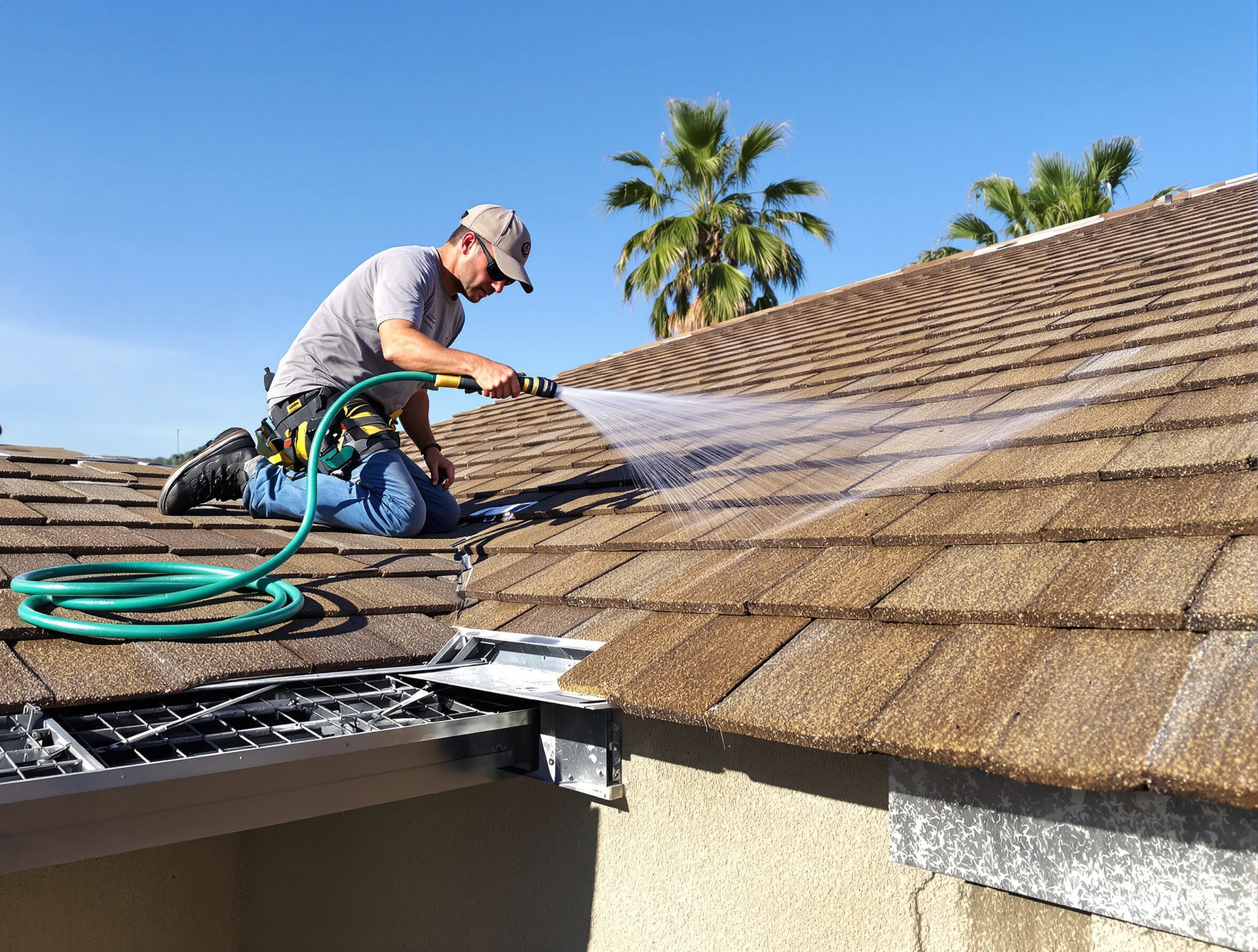
Then test it with water. One person on the roof runs a garden hose over one small section at a time, and a second person waits in the attic with a light, watching for the first drop.2 Start low on the roof and work up, so you know which section let the water in. Use a gentle flow. A hard spray can force water up under shingles that would shed real rain.
Only get on the roof if it's safe. A wet roof, a two story house or concrete tile that cracks underfoot is a job for a pro with fall protection. Asking a roofer to run this test is reasonable, and the results tell you whether a second repair has a chance.
A Leak Hunt You Can Run in an Afternoon
- Photograph the ceiling stain, the attic and the outside of the roof before anyone touches it
- In the attic, look for dark wood and wet insulation, then follow it uphill
- Mark the wettest spot on a rafter with tape so you can find it again
- Check the drain pan under any attic air handler for standing water
- On a dry day, run a gentle hose flow on one small roof section at a time
- Start at the lowest section and work up, waiting a few minutes between sections
- Keep a helper in the attic with a light to call out the first drop
- Write down which section made it drip and share that with your roofer
Your Rights When a Repair Fails in California
A failed repair isn't always the roofer's fault. A new leak in a different spot on an old roof may be a new problem. But a repair that never held deserves a straight conversation, and California gives you tools.
Read the written contract first. Look for what it says about workmanship and how long that promise lasts. Whatever the roofer put in writing is what you can point to.
Put the problem in writing. The Contractors State License Board will ask whether you formally told the contractor about your concerns, and it offers a sample letter in English and Spanish that you should keep a copy of.9 Send photos of the stain, the attic and the repair area with your letter.
Know where the bar sits. Under Business and Professions Code section 7109, a willful departure in any material respect from accepted trade standards for good and workmanlike construction is a cause for disciplinary action.8 The CSLB handles license law violations for up to four years from the date of the act.9
Know what the CSLB won't do. Its own page says an investigation is not meant to get you your money back and does not guarantee restitution. People whose main goal is recovering money should look at the courts.9 Small claims court in California generally handles cases up to $12,500 for an individual.10
Don't count on your home policy for the repair itself. The sample HO 3 policy excludes loss caused by faulty, inadequate or defective workmanship or repair, but it says any ensuing loss not excluded elsewhere is covered.^7] So a bad patch usually isn't paid for, while some of the water damage it led to may be. Your own policy wording decides it. Our [roof leak insurance guide walks through the rest.
Before you hire anyone for the second try, look up the license on the CSLB license search.11
Repair It Again or Replace It?
One leak that came back is a diagnosis problem. Three leaks in three places is a roof problem.
Repair again when the hose test finds one clear entry point, like a cracked vent collar, a bad flashing joint or a lifted shingle, and the rest of the roof is in decent shape. Ask for photos of the problem before and after the fix.
Look at the underlayment when it's a tile roof that's had more than one tile repair over the same area. The tile may be fine to reuse, since the code allows clean, undamaged cement tile to be reinstalled.^4] What usually needs replacing is the layer under it, and that's a [tile underlayment replacement, not another patch.
Plan a replacement when the roof is near the end of its life and every winter brings a new wet spot. Our roof leak repair page covers what a full leak job includes, and our post on roof leaks in heavy rain explains why big storms find spots that light rain misses.
If you're in Ontario or the west Inland Empire, call Ontario Roofing at (909) 404-9464 for a free written estimate, with photos of what we find.
People Also Wonder
Is it normal for a roof to leak after a repair?
No. A sound repair should hold through the next storm. When it doesn't, the fix most often went on the wrong spot, or there was a second leak nobody found.2 A brand new leak in a different area of an old roof can be a separate problem.
How long should I wait to see if a roof repair worked?
In Ontario, don't wait for rain. The six months from May through October average about 2.3 days with a tenth of an inch of rain or more, so a summer repair might not get tested until winter.1 Ask for a hose test on a dry day instead.
Should I call the same roofer back or get a second opinion?
Call the first roofer back first and put it in writing, since the CSLB will ask whether you formally told them.9 If they can't show you the real entry point with photos, a second roofer with a fresh set of eyes is worth it.
Why does my ceiling leak when it hasn't rained?
In a dry Ontario summer, the usual cause is the air conditioner. A clogged condensate drain fills the pan under an attic air handler, and an overflow or a rusted pan drips onto the ceiling.5 Plumbing lines are the other common source.
Will insurance pay to redo a bad roof repair?
Usually not the repair itself. The sample HO 3 policy excludes faulty or defective workmanship and repair, but it covers ensuing loss not excluded elsewhere, so some water damage may still be paid.7 Your own policy's wording is what counts.
Further Proof
- NOAA NCEI: 1991 to 2020 monthly climate normals, Ontario International Airport (USW00003102)
- Bob Vila: How to Find a Roof Leak
- Eagle Roofing: Ask the TRI Expert, Roof Protection, Tiles and Underlayment (April 6, 2017)
- 2022 California Residential Code, Chapter 9 Roof Assemblies, R903.2, R908.5 and R908.6 (UpCodes)
- Energy Vanguard: The Attic Air Handler That Makes Its Own Rain (Allison Bailes, September 24, 2026)
- US EPA: A Brief Guide to Mold, Moisture and Your Home
- Insurance Services Office: Homeowners 3 Special Form, HO 00 03 10 00, sample policy (Insurance Information Institute)
- California Business and Professions Code section 7109 (2025)
- Contractors State License Board: Filing a Construction Complaint
- Judicial Branch of California: Small Claims in California
- Contractors State License Board: Check a License
Want more roof advice from us when you search Google?
Like this? Add Ontario Roofing to your Google sourcesNext Moves
We do this work in Ontario, Rancho Cucamonga, Upland, Chino, Chino Hills, Fontana, Montclair, Eastvale, Pomona, Claremont. See every service.
Where to Find Ontario Roofing
4335 E Lowell St Ste G, Ontario, CA 91761
Get a Free Roof Estimate
Tell us what your roof is doing. We look, take photos and give you a written price.