How to Spot Wind Damage on Your Roof After a Santa Ana
Wind damage shows up first at the edges, hips and ridge of a roof, as creased or missing shingles, or as ridge and edge tiles knocked out of line.67 Check those spots from the ground or a ladder within a day or two of a big Santa Ana, because the wind and the rain share a season here. November through March brings about 86 percent of Ontario's normal yearly rain.8 Wind data updated October 2026.
Skip to the Answer
- Ten years of Ontario airport readings show 44 days with gusts of 47 mph or more, and every one fell between October and March.1
- Gusts of 47 to 54 mph are where NOAA's wind scale starts to list slight structural damage.4
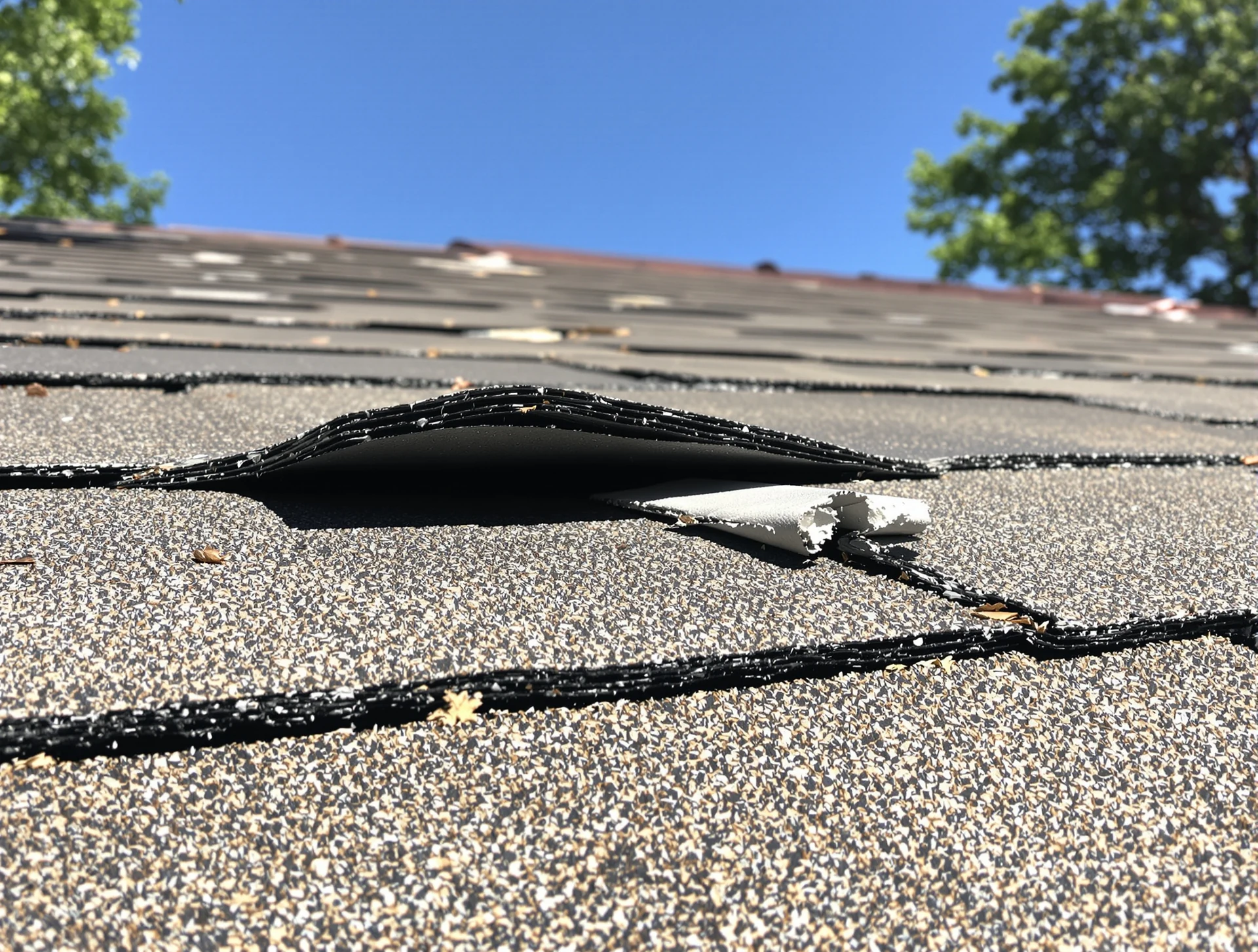
- On shingles, a crease across the top of the exposed tab is the mark wind leaves. A loose tab with no crease or tear often is not wind.6
- On tile, older mortar set ridge and hip tiles are the first to go, and you should not walk on the roof to check.7
- Shingle wind classes D, G and H are rated for gusts up to 116, 155 and 194 mph under set test conditions.5
Santa Ana Season Is Roof Damage Season
Our worst roof wind comes in a short, fierce window. The National Weather Service describes Santa Ana winds as air that pours east to west through the mountain passes of Southern California, and says they can cause major property damage.2
A National Weather Service climate bulletin puts these events most often in October through March, usually lasting one to five days, and sometimes ten or more.3
We wanted the local numbers, so we counted them. We went through every gust the weather station at Ontario International Airport logged from January 2016 through December 2025, using the public archive kept by the Iowa Environmental Mesonet.1 We kept the strongest gust of each day.
Over those ten years the station logged 84 days with a gust of 40 mph or more. 81 of those days fell between October and March, and 80 of the 84 peak gusts came out of the north or east, the Santa Ana direction.1
It logged 44 days at 47 mph or more, all of them in October through March. January led with 15 of those days, then December with 9 and November with 8.1
The top reading was 76 mph late on January 9, 2025, out of the northeast. The second was 70 mph on October 26, 2020.1 So yes, October can bring the real thing.
Days With Gusts of 47 Mph or More in Ontario
Where Wind Hits a Roof First
Wind does not push evenly on a roof. It pulls hardest at the edges and the high points.
A paper published by the International Institute of Building Enclosure Consultants found wind damage on shingle roofs is worst where wind forces run higher, at the eaves, hips and ridges.6 The tab usually fails right at the top of its exposed part, just below the shingle above it.6
Tile follows the same pattern. Florida's Division of Emergency Management says older mortar set hip and ridge tiles are the first to blow off, once gusts start passing about 80 to 90 mph. It says the first row of tiles at the eaves sees wide damage when gusts climb past 100 mph.7
Ontario gusts rarely reach those numbers, but our tile roofs are old. Mortar that has cracked and let go after 25 summers does not need a hurricane to drop a ridge cap. Start every check at the ridge, then the hips, then the rakes and eaves.
| Gust Speed | What the Sources Say Happens |
|---|---|
| 39 to 46 mph | Twigs break off trees, per NOAA's Beaufort scale4 |
| 47 to 54 mph | Slight structural damage, slate blows off roofs4 |
| 55 to 63 mph | Trees broken or uprooted, considerable structural damage4 |
| About 80 to 90 mph | Older mortar set hip and ridge tiles start to blow off7 |
| Above 100 mph | Wide damage to the first row of tiles at the eaves7 |
| Up to 116 / 155 / 194 mph | Design limits for shingle wind Class D, G and H under set test conditions5 |
The Signs on a Shingle Roof
A crease is the giveaway. In wind testing cited in the IIBEC paper, every shingle that came unstuck showed at least a crease.6 On a newer, soft shingle that crease can be faint, so look for a straight line across the top of the tab.
Missing tabs or whole shingles. A clean gap that shows the darker shingle below, nail heads, or bare felt means the wind won. Pieces in the yard or the gutter tell you which side of the house took it.
Lifted edges that flap. A tab that lifts and drops in a breeze has lost its seal. Once it starts moving, every gust bends it more, and then it creases, flips and tears.6
Not every loose shingle is wind. The same paper says a tab that is unstuck but has no crease, fold, tear or missing piece is not wind damage.6 It also notes that shingles tend to stay sealed for about the first four to five years, and that unsealing gets more common after that from age, heat cycles and install mistakes.6 An adjuster will look for that difference, so it helps to know it before they arrive.
If you are buying new shingles, look on the bundle for the ASTM D7158 class. The Asphalt Roofing Manufacturers Association lists Class D for basic wind speeds up to 116 mph, Class G up to 155 mph and Class H up to 194 mph, all as three second gusts, on a roof no taller than 60 feet in standard exposure.^5] Our [shingle roofing page covers what goes under them.
The Signs on a Concrete Tile Roof
Concrete tile is heavy, so wind rarely peels a field of it. The trouble spots are the pieces held on by mortar or a single nail.
Ridge and hip caps out of line. A cap tile that sits crooked, or a gap where gray mortar shows, means the bond broke. Florida's guide says to look along ridges, gable edges and eaves for cracked, broken or loose tile, and to note whether the caps are set in mortar or fastened to a ridge board.7
Tile shards on the ground. A broken cap often lands in the yard or on a lower roof. Look before you mow.
Slipped field tiles. A tile that slid down a few inches leaves a dark strip of bare underlayment above it. That strip is now taking the sun and the rain the tile used to block.
Light in the attic. Florida's guide suggests going into the attic on a sunny day and looking for daylight through cracks or holes, and for water stains on the wood, with extra care near chimneys, vents and spots where the roof changes slope.7
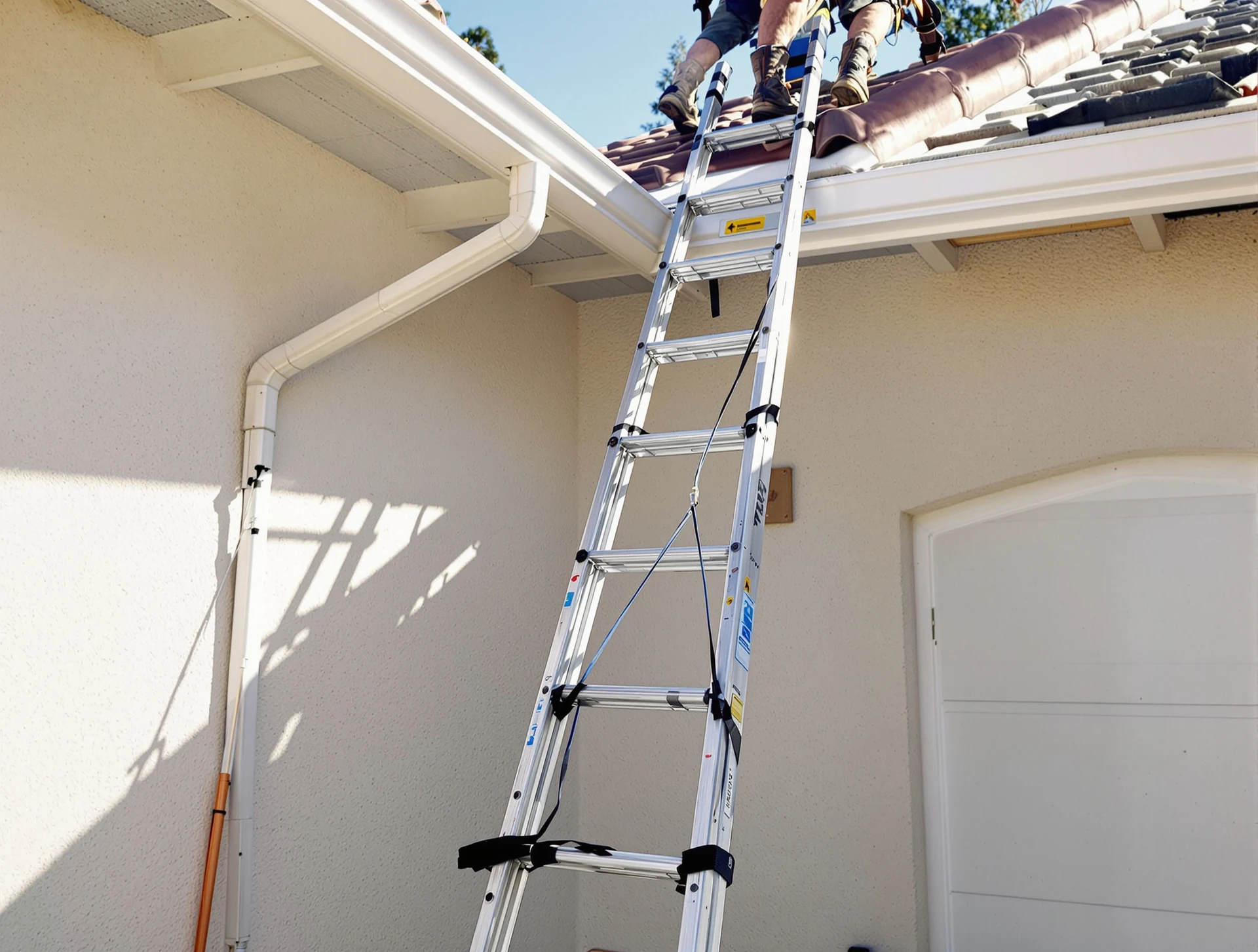
Stay off the tile. The same guide warns that walking on the roof can break the mortar bond or crack tiles.^7] A ladder at the eave and a pair of binoculars do the job. If a few tiles need swapping, our [tile roofing page shows how that repair works.
The 10 Minute Walk Around After a Santa Ana
- Stand back far enough to see the whole ridge line from the street
- Look for ridge or hip caps that sit crooked or show gray mortar
- Scan the rakes and eaves for lifted, creased or missing shingle tabs
- Check the yard, side yards and gutters for shingle pieces or tile shards
- Look for dark strips of bare underlayment where a tile slid down
- On a sunny day, look for daylight from inside the attic
- Photograph everything with the date before any cleanup
- Stay off a tile roof and off any roof that is wet
What to Do the Day After a Wind Event
Write down the date and time. You don't have to guess at a gust. The airport readings are public, and they show the day and hour the wind peaked.1
Photograph before anything moves. Shoot the roof from every side of the house, the pieces in the yard and the attic. Wide shots first, then close ups.
Cover any opening before the rain. Ontario's normals put 9.97 of its 11.64 yearly inches of rain in November through March, the same stretch as the strongest gusts.^8]1 A missing shingle or a slipped tile can sit dry for weeks and then leak the first night it rains. If the deck or underlayment is open to the sky, an [emergency roof repair or a tarp buys time.
Get a written estimate with photos. A roofer who goes up and shoots each damaged spot gives you a record you can hold up next to an adjuster's report. Our roof repair page lists the common fixes.
Know how your insurance reads wind. The Insurance Information Institute says windstorm damage is covered under homeowners insurance, while an old roof on an actual cash value policy can be paid down a lot for depreciation.^9] Our [roof leak insurance guide walks through where the line between wind and wear falls.
For a free written estimate with photos of every spot the wind found, call Ontario Roofing at (909) 404-9464.
People Also Wonder
What wind speed will damage a roof?
NOAA's Beaufort scale lists slight structural damage at 47 to 54 mph and considerable damage at 55 to 63 mph.4 Old mortar set ridge tiles and shingles that already lost their seal can fail at lower gusts than a sound roof.
How do I know if my roof is damaged by wind?
Look at the ridge, hips and edges first. On shingles, look for creases, lifted tabs and missing pieces.6 On tile, look for crooked ridge caps, broken tile and slipped tiles, and check the attic for daylight.7
How do you fix shingles that are lifting?
It depends on whether the tab is only unstuck or also creased or torn. A creased or torn tab has been bent by the wind and keeps bending in each new gust until it tears off.6 Have a roofer look at both kinds and fix them before the rain.
Does insurance cover wind damage to shingles?
Usually, yes. The Insurance Information Institute says windstorm damage is covered under homeowners insurance.^9] Wear and age are a different story, and our [roof leak insurance guide explains how that line is drawn.
When do Santa Ana winds happen in Ontario?
Mostly October through March.3 At Ontario's airport, every day from 2016 through 2025 with a gust of 47 mph or more fell in those months.1
Should I get on the roof to check after a windstorm?
No. On tile, walking can crack tiles and break the mortar.^7] Use a ladder at the eave, binoculars and the attic. A free [roof inspection is the safer way to see the top.
Further Proof
- Iowa Environmental Mesonet: ASOS archive download, Ontario International Airport (ONT), gust readings January 2016 to December 2025
- National Weather Service: Mountain and Valley Winds
- NOAA National Weather Service Climate Bulletin: Murphree, Szasz and Jones, Santa Ana Events in California (2018)
- NOAA Storm Prediction Center: Beaufort Wind Scale
- Asphalt Roofing Manufacturers Association: Using ASTM D7158 Where Standard Conditions Do Not Apply (March 2026)
- IIBEC: Misconceptions of Wind Damage to Asphalt Composition Shingles, Lopez, Goode and Morrison
- Florida Division of Emergency Management: Tile Roofs, Homeowner's Retrofit Guide
- NOAA NCEI: 1991 to 2020 monthly precipitation normals, Ontario International Airport (USW00003102)
- Insurance Information Institute: Am I Covered?
Want more roof advice from us when you search Google?
Like this? Add Ontario Roofing to your Google sourcesNext Moves
We do this work in Ontario, Rancho Cucamonga, Upland, Chino, Chino Hills, Fontana, Montclair, Eastvale, Pomona, Claremont. See every service.
Where to Find Ontario Roofing
4335 E Lowell St Ste G, Ontario, CA 91761
Get a Free Roof Estimate
Tell us what your roof is doing. We look, take photos and give you a written price.