Run This Roof Maintenance Checklist Before the Next Rain
Check six things before the next storm, in this order. Valleys, gutters and downspouts, flashing and vent boots, the tile or shingle field, flat roof drains, and the attic. You can do nearly all of it from the ground and one ladder stop at the gutter. It matters more in Ontario than in wetter towns, because our rain shows up in a handful of hard days after months of nothing. Rain numbers updated November 2026.
Skip to the Answer
- By our count from 11 rain years of Ontario airport records, only 87 days brought half an inch of rain or more. That's about 8 days a year.1
- Those 87 days were about 2% of the calendar and about 70% of all the rain that fell.1
- About 86% of the rain fell from November through March, which matches NOAA's 30 year normals for the same airport.12
- Stay off a tile roof. IBHS warns that walking on tile the wrong way can damage the roof.3
- Set a ladder with its base a quarter of its working length out from the wall, and keep three points of contact.4
- In California, a repair of $1,000 or more in labor and materials takes a licensed contractor.5
Why Ontario Roofs Get Caught on the First Hard Rain
A roof in Ontario isn't worn down by steady rain. It's tested a few times a year, hard, after sitting dry for most of the year. That's why small problems hide so well here.
We pulled every daily rain total for Ontario International Airport from July 2015 through June 2026, about 4,000 days, from the Iowa Environmental Mesonet archive.1 Then we counted the soaking days, the ones with half an inch or more. There were 87 of them in 11 rain years. That's about 8 a year. The driest year had 2. The wettest had 18.1
Those 87 days were about 2% of the calendar. They brought about 70% of all the rain.1 So most of the water your roof sees in a year lands in about a week's worth of days.
They cluster, too. January had 22 of the 87 soaking days. February and March had 17 each, December had 15 and November had 8. April through October had 8 combined.1 About 86% of all the rain fell from November through March.1 NOAA's 1991 to 2020 normals for the same airport say the same thing, with 9.97 of the year's 11.64 inches falling in those five months.2
The dry gap is the trap. In 9 of the last 10 seasons, the first soaking day came after more than 200 days without one.1 That's seven months of leaves, dust and Santa Ana debris piling up in valleys and gutters with nothing to flush them out.
Summer does its own damage in that gap. IBHS says sun can push a roof surface past 200 degrees, and that the sealant strip holding asphalt shingles down weakens after 7 to 10 years.3 Rubber vent collars and old sealant bake the same way. None of it shows until water arrives.
This season is already underway. The airport logged soaking days on October 11 and October 22, 2026, and lighter rain on November 13 and 14.1 The National Weather Service forecast for Ontario issued November 15 showed more showers the night of Monday, November 16, and a stronger system late Wednesday into Thursday.9 If you haven't looked at your roof yet, this is the week.
When Ontario's Soaking Rain Days Land
Start on the Ground With Binoculars
You don't need to get on the roof for the most useful part of this checklist. Walk the whole house from the yard and the street with binoculars or your phone's zoom. Look at four things.
Valleys. A valley is the channel where two roof slopes meet. It carries more water than any other part of the roof. Look for leaves, pine needles, palm fronds or a bird nest piled in it. On a tile roof, a packed valley works like a dam. Water backs up, runs sideways under the tile and sits on the underlayment.
That underlayment matters more than it looks. The Tile Roofing Industry Alliance explains that tile is the main water shedding layer and the underlayment is the backup for wind driven rain.10 On a lot of Ontario tract homes from the 1980s and 1990s, that backup layer is old and brittle. A dammed valley sends water straight to the weakest part of the roof.
Flashing and vent boots. Flashing is the metal that seals the joints around chimneys, walls, skylights and pipes. Look for metal that's lifted, bent or rusted through. Then find the pipes sticking out of the roof. Each one has a collar, and the rubber kind cracks in our sun. A split collar is a leak we trace a lot, and you can often spot it from the driveway.
The field. That's the big open part of the roof. On tile, look for pieces that have slipped down, cracked or gone missing, most often along ridges and edges. On shingles, look for missing tabs, corners that curl up, and dark bare patches where the granules are gone. If the last Santa Ana lifted anything, our guide to wind damage after a Santa Ana shows what that looks like.
Trees. Any branch that touches the roof or hangs over it will drop debris in the next wind and can scrape or crack what's under it. IBHS says to keep debris off the roof and trim trees back from the surface.3
Write down what you see and take a photo of each problem. You'll want those photos later, whether you fix it yourself or call someone.
| Check | Where You Stand | Trouble Looks Like | Who Fixes It |
|---|---|---|---|
| Valleys | Ground, with binoculars | Leaves, needles or a nest packed in the channel | A roofer on tile roofs |
| Gutters and downspouts | Ladder at the eave | Packed debris, sagging runs, hose water that won't come out the bottom | You, on a one story home |
| Flashing and vent boots | Ground, with binoculars | Lifted or rusted metal, cracked rubber collars, gaps in old sealant | A roofer |
| Tile or shingle field | Ground and the street | Slipped, cracked or missing pieces, curled corners, bare dark patches | A roofer |
| Skylights | Inside, then the ground | Stains at the corners, debris dammed on the uphill side | A roofer |
| Flat roof drains and scuppers | Ladder or a safe walkable roof | Debris over the drain, rings of dried mud, low spots | You for loose debris, a roofer for standing water |
| Attic and ceilings | Inside, with a flashlight | Stains, soft or dark wood, pinholes of daylight | A roofer traces the source |
| Trees | Ground | Branches touching or hanging over the roof | A tree service |
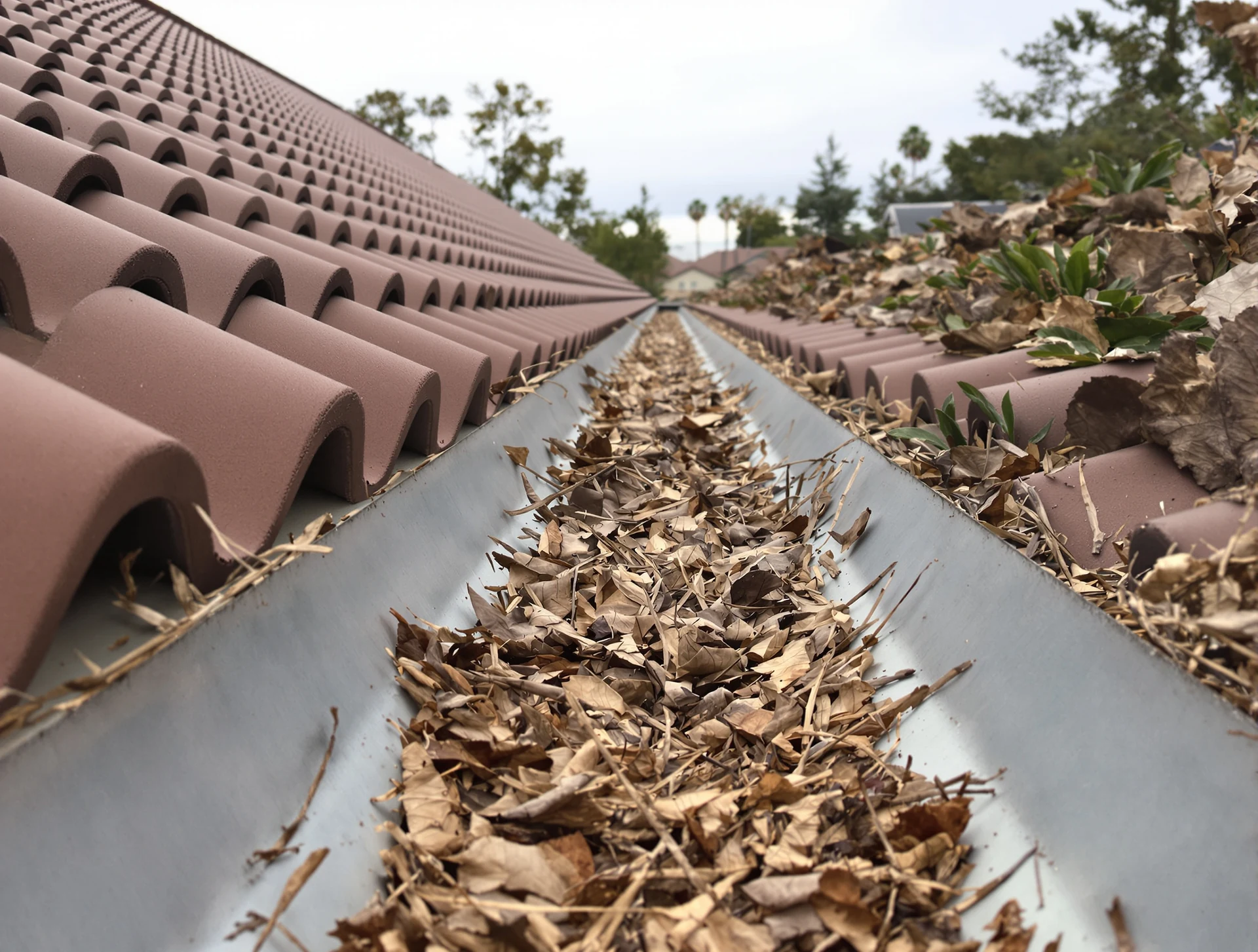
Make One Ladder Stop at the Gutter
Gutters are the one part of this job a homeowner on a one story house can reasonably do. On a two story house, or anywhere the ground is sloped or soft, hand it off.
Set the ladder right first. OSHA's ladder card is written for workers, and the rules fit homeowners just as well. Put the ladder on stable, level ground. Set the base a quarter of the ladder's working length out from the wall. Keep three points of contact, meaning two hands and a foot or two feet and a hand. Don't stand on the top three rungs of an extension ladder. Look up for power lines before you move it.4
Work from the ladder, not from the roof. Don't step off onto tile. Move the ladder often so you never lean out past the rails.
Clear the run. Scoop the debris into a bucket by hand. The EPA lists cleaning and repairing roof gutters regularly as a basic way to keep moisture out of a house.6 While you're there, look at the hangers. A gutter that sags or has pulled away from the fascia board will spill water behind it.
Then test it. This is the step that gets skipped. Run a garden hose into the gutter at the far end and watch the bottom of the downspout. Water should come out fast and clear. If it trickles or backs up, the clog is in the downspout, usually at the top elbow. A gutter that looks clean and drains nowhere is still a clogged gutter.
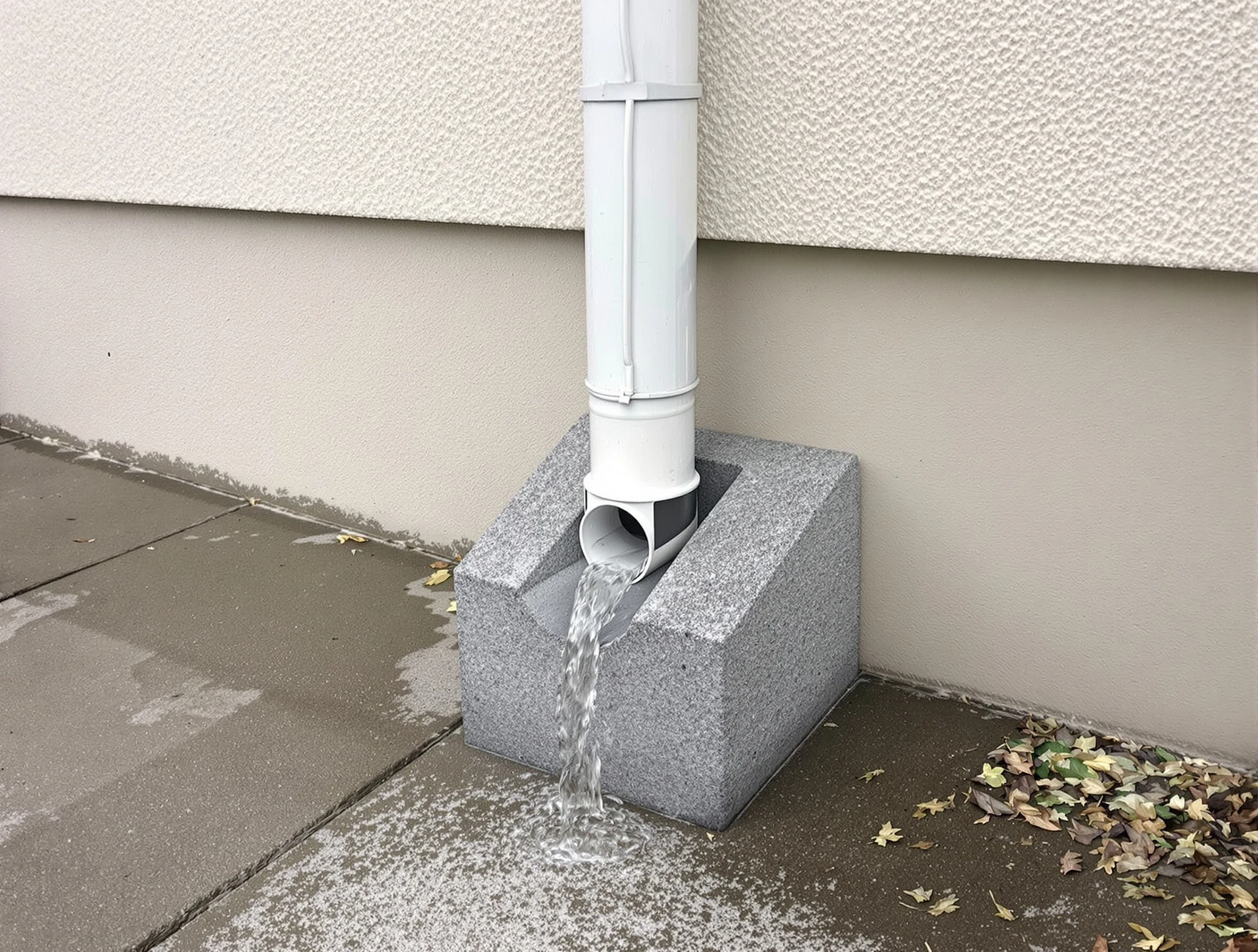
Check where that water goes last. It should land on a splash block or run into a drain line that carries it away from the wall. A downspout that dumps beside the foundation or onto a lower roof is moving the problem, not solving it. If the runs are bent, leaking at the seams or missing pieces, that's work for our gutter and roof drain repair crew.
Flat Roofs and Patio Covers Need Their Drains Open
Ontario has plenty of low slope roofs. Think garage additions, patio covers, mid century homes and nearly every commercial building. They don't shed water the way a pitched roof does. They move it slowly to a drain or a scupper, which is an opening through the edge wall. If that one opening is blocked, the roof turns into a pond.
Look for three things. Debris sitting on or around the drain. Rings of dried mud that show where water stood last winter. And any low spot far from a drain. Clearing loose leaves off a drain you can reach safely is fine. Standing water that stays for days after rain is a slope or membrane problem, and that goes to a roofer who does flat roofing.
Don't forget the patio cover. Where it ties into the house wall is a classic leak spot, because the joint depends on flashing and sealant that nobody looks at for years.
Finish in the Attic and at the Ceilings
The inside of the house tells you what the outside can't. Take a flashlight into the attic on a bright day. Look at the underside of the roof boards around every pipe, vent, chimney and valley. Dark stains, gray streaks or wood that feels soft mean water has been there before. Pinholes of daylight where there shouldn't be any mean it will be there again.
No attic access? Walk the rooms. Check ceilings at outside walls, around skylights and under bathrooms with roof vents. A faint yellow ring is last winter's leak telling you where to look this winter.
Take photos of everything, good and bad. A dated set of photos showing your roof and ceilings before the storm is useful if you ever file a claim. The California Department of Insurance tells homeowners to photograph damage, make temporary repairs to prevent more of it, and save the receipts for materials.^7] Our post on [roof leaks and insurance in California walks through the rest.
What You Can Fix and What Needs a Roofer
Cleaning a reachable gutter, clearing a flat roof drain, trimming a small branch and taking photos are homeowner jobs. Nearly everything else on this list isn't, and there are three reasons.
Tile breaks under feet. IBHS warns that inspections and maintenance on tile need care, because walking on it the wrong way can damage the roof.3 We see it every wet season. Someone climbs up to fix one cracked tile and leaves a few more behind. On tile, even clearing a valley is a job for someone who knows where to step.
Sealant smeared on top is not a repair. A tube of roof cement over a cracked collar or a lifted flashing may get you through one storm. It also hides the real problem and makes the proper fix harder. We covered what patch products can and can't do in our Flex Seal guide.
The law draws a line at $1,000. Since January 1, 2025, California lets an unlicensed person take a job only if the total for labor, materials and everything else is under $1,000, no permit is needed and they don't hire workers.5 Above that, the person on your roof needs a contractor's license. Look up any license for free on the CSLB site before anyone starts.11
If your walk around turned up slipped tile, lifted flashing, cracked collars or stains inside, book a roof inspection while it's still dry. Roofers get very busy the week after the first real storm. A small roof repair done on a dry day is easier to schedule and easier to do right.
The One Afternoon Version
- Walk the house with binoculars and photograph every valley, pipe collar and flashing you can see.
- Note any slipped, cracked or missing tile or shingle.
- Set the ladder on level ground and clear the gutters by hand.
- Run a hose into each gutter and watch the bottom of the downspout.
- Clear loose debris off any flat roof drain or scupper you can reach safely.
- Check the attic and the ceilings with a flashlight.
- Save the photos in one dated folder.
- Call a licensed roofer about anything on the roof surface itself.
If the Rain Beats You to the List
Sometimes the storm gets there first. If water shows up inside, catch it, move what you can and poke a small hole in a bulging ceiling so it drains into a bucket instead of spreading. Then dry things fast. The EPA says that if wet materials are dried within 24 to 48 hours, mold won't grow in most cases.6
Don't go up on a wet roof. A tarp is the right stopgap for an open leak, and it's safer in a pro's hands. Our post on emergency roof tarps covers what that should cost and how long one lasts.
For water on the ground, the City of Ontario gives residents free sandbags during heavy rain and flooding. You can pick up as many as fifteen empty bags at any Ontario fire station. Sand is at De Anza, John Galvin, Anthony Munoz and Whispering Lakes parks, and you bring your own shovel.8
Ontario Roofing answers the phone 24 hours a day at (909) 404-9464 and gives free written estimates.
People Also Wonder
What is routine maintenance on a roof?
It's keeping water moving and catching small failures early. That means clear valleys, gutters and drains, sound flashing and vent collars, no slipped or missing tile or shingles, and trees trimmed back. IBHS also says to check the flashing around vents and pipes regularly on any roof.3
How often should I clean my gutters in Ontario, CA?
At least once before the wet season, after the fall leaf drop and the last big Santa Ana. If trees hang over the roof, check again in midwinter. By our count, 79 of the airport's 87 soaking days in 11 rain years fell from November through March, so late October or early November is the target.1
Can I walk on my tile roof to check it?
We'd tell you not to. IBHS warns that walking on tile the wrong way can damage the roof, and a cracked tile exposes the underlayment below it.3 Use binoculars from the ground and leave the roof surface to a roofer.
Is it too late for roof maintenance once the rain has started?
No. Ontario's soaking days are spread from November through March, with January the busiest month in our count.1 Use the dry days between storms. Gutters and drains can be cleared any dry afternoon, and a roofer can make repairs once the surface dries.
What should I do the day before a big storm?
Clear the gutters and any flat roof drain, test the downspouts with a hose, move patio items that could blow onto the roof, and take dated photos of the roof and ceilings. If you already know about a weak spot, call a roofer about a temporary cover before the rain, not during it.
Further Proof
- Iowa Environmental Mesonet, ASOS daily summary archive, Ontario International Airport (ONT), daily precipitation July 2015 to November 2026
- NOAA NCEI, 1991 to 2020 monthly precipitation normals, Ontario International Airport (USW00003102)
- Insurance Institute for Business and Home Safety, Natural Weathering and Hazard Exposure
- OSHA, Portable Ladder Safety QuickCard (OSHA 3246)
- Contractors State License Board, Handyperson Exemption to Increase to $1,000 in 2025 (December 30, 2024)
- U.S. EPA, A Brief Guide to Mold, Moisture and Your Home
- California Department of Insurance, Residential Property Claims Guide
- City of Ontario, Sandbag Distribution
- National Weather Service, point forecast for Ontario, CA
- Eagle Roofing, Ask a TRI Alliance Expert, Roof Protection With Tiles and Underlayment (April 6, 2017)
- Contractors State License Board, Check a License
Want more roof advice from us when you search Google?
Like this? Add Ontario Roofing to your Google sourcesNext Moves
We do this work in Ontario, Rancho Cucamonga, Upland, Chino, Chino Hills, Fontana, Montclair, Eastvale, Pomona, Claremont. See every service.
Where to Find Ontario Roofing
4335 E Lowell St Ste G, Ontario, CA 91761
Get a Free Roof Estimate
Tell us what your roof is doing. We look, take photos and give you a written price.